Internal AM Distortion

AM distortion is defined as the square root of the ratio of the power contained in the harmonics of the demodulated AM waveform to the power of the fundamental component of the demodulated waveform.

This is essentially a total harmonic distortion (THD) measurement, and is made directly by the audio analyzer. The THD indicated by the audio analyzer includes the distortion added by the measuring receiver.

Required Test Equipment

Instrument

Critical Specifications for This Test

Recommended Model1

Measuring Receiver

AM Demodulated Distortion (<50% AM) ≤ 0.3%

8902A

Audio Analyzer

Distortion (20 Hz to 20 kHz) < –80 dB2

8903B

Mixer3

RF/LO Freq. Range: 1 to 2800 MHz
IF Frequency Range: 1.5 MHz
RF 1 dB compression: +8 dBm
RF/LO Freq. Range: 500 to 9000 MHz
IF Frequency Range: 50 MHz

M/A-COM MDC-164

Local Oscillator3

Frequency Range: 800 to 2500 MHz

Amplitude:16 dBm

E8267D

  1. Refer to the main equipment list for alternate models.
  2. The distortion accuracy of the 8903B is worse than the specified AM distortion of the DUT. Therefore, the indicated distortion must be greater than the specification by at least the amount of the 8903B distortion measurement accuracy.
  3. Not used for ESGs with frequency range < 2 GHz.

Connections and Setup Procedures

  • All test equipment requires a 30 minute warm-up period to ensure accurate performance.
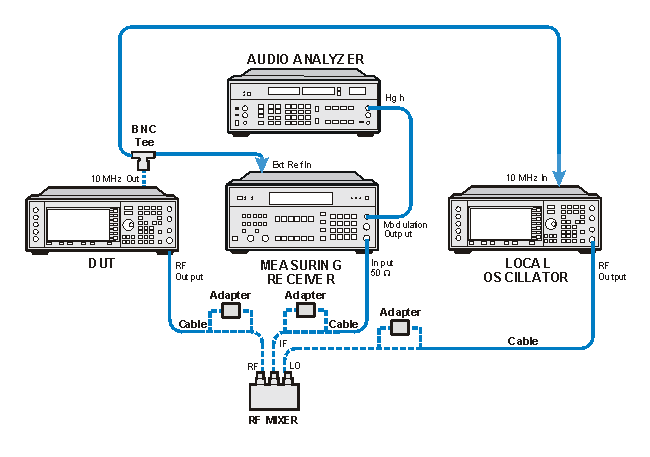
  • In the following test setup, direct cable and adapter connections are designated as solid lines. Changeable cable and adapter connections are designated as dashed lines.
  • Connect all test equipment as shown.
  • Connect GPIB cables to all GPIB-controlled test equipment.
  • While performing this test, follow all instructions on the controller display.


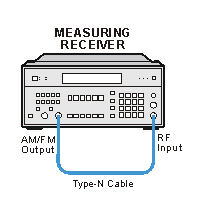
Measuring Receiver Calibration Setup


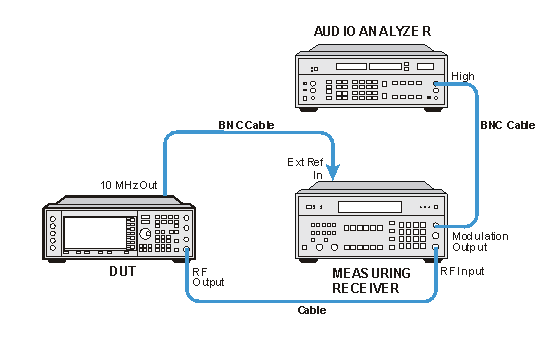
AM Distortion CW Frequency
< = 1300 MHz Test Setup

AM Distortion CW Frequency > 1300 MHz