Non-Harmonic Spurious
Non-harmonic
spurious responses
are unwanted signals that are not related to the fundamental output frequency
of the DUT that are produced by the internal frequency synthesis of the
DUT. This test utilizes a spectrum analyzer to measure the amplitude of
these responses relative to the amplitude of a fundamental frequency.
To eliminate
the effect of the spectrum analyzer’s frequency response error,
a ”r;flatness calibration” is performed at each measured test
point. To do this, the DUT is set to the non-harmonic frequency at the
specified power level, and then spectrum analyzer performs a marker-peak-search
and a marker-peak-to-reference-level. The DUT is then set to the fundamental
frequency at the same power level and the spectrum analyzer performs a
marker-delta measurement to determine the difference between the fundamental
and non-harmonic components. This
”r;calibration” is done for every test point up to the frequency
limit of the DUT.
Required Test Equipment
|
Spectrum Analyzer
|
None
|
E444xA2 Opt 1DS, 1233
|
|
10 dB Attenuator
|
None
|
8491B Opt 010
|
- Refer to the main equipment list for alternate models.
- Depending on your frequency range
needs, choose either an E4440A, E4443A, E4445A, E4446A, or E4448A. (E4447A is for Power Level Accuracy adjustment only.)
- Options 1DS and 123 are for ESGs > 3 GHz.
|
Connections and Setup Procedures
|

|
- All test equipment requires a 30 minute warm-up period to ensure accurate
performance.
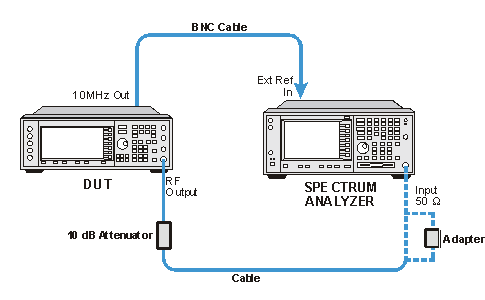
- In the following test setup, direct cable and adapter connections are designated
as solid lines. Changeable cable and adapter connections are designated
as dashed lines.
- Connect all test equipment as shown.
- Connect
GPIB cables to all GPIB-controlled test equipment.
- While
performing this test, follow all instructions on the controller display.
|