Pulse Modulation Rise/Fall Time

(Option 1E6)

This test verifies that the internal pulse modulator's rise and fall time meets specifications.

Pulse modulation rise/fall time is defined as the amount of time it takes the pulse envelope to transition from the 10% pulse envelope level to the 90% pulse envelope level on both the rising and falling edges of the pulse.

During the test, the signal generator is placed in an internal pulse modulation mode at a certain power level and the rise and fall time of the pulse envelope is measured with a high-frequency, digitizing oscilloscope.

Required Test Equipment

Instrument

Critical Specifications for This Test

Recommended Model1

High Frequency Oscilloscope Mainframe

 6 GHz BW

86100D

Oscilloscope Plug-In

Time Interval Accuracy

86117A

Pulse Generator

Rise and Fall time < 1 ns

81130A

10 dB Attenuator

none

8491B Option 010

20 dB Attenuator

none

8493C Option 020

  1. Refer to the main equipment list for alternate models.

Connections and Setup Procedures

  • All test equipment requires a 30 minute warm-up period to ensure accurate performance.
  • In the following test setup, direct cable and adapter connections are designated as solid lines. Changeable cable and adapter connections are designated as dashed lines.
  • Connect all test equipment as shown.
  • Connect GPIB cables to all GPIB-controlled test equipment.
  • While performing this test, follow all instructions on the controller display.
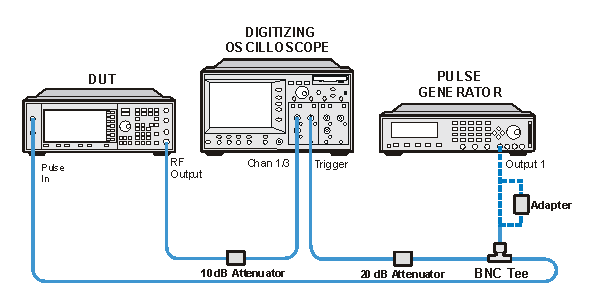
 

Setup for Pulse Modulation Rise/Fall Time (using plug-in trigger)

Setup for Pulse Modulation Rise/Fall Time (using mainframe trigger)