Residual FM

Residual FM is unwanted frequency modulation of the ESG CW output.

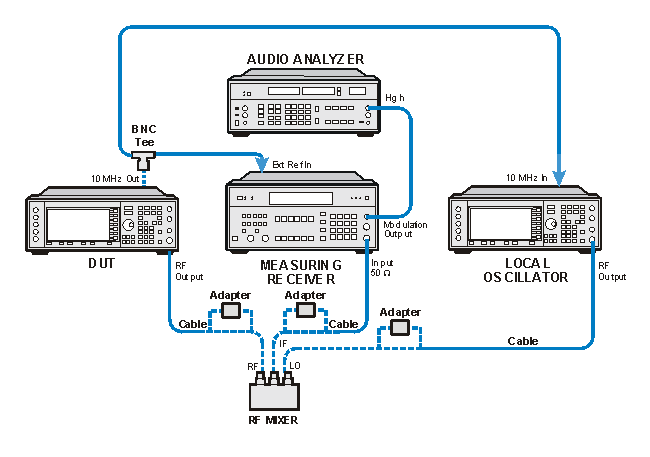
The 8902A measuring receiver measures the deviation (in Hz) of the residual FM. Because the display resolution of the measuring receiver is not high enough to discern low deviations (i.e., low residual FM), the FM deviation signal from the 8902A is passed along to an audio analyzer, where the AC level is measured.

The 8902A FM deviation output level is 1 mV per Hz of deviation.

The measuring receiver has an internal L.O. to down-convert the RF Input to its 1.5 MHz I.F. Unfortunately, this internal L.O. does not have optimum phase noise for a residual FM measurement. For this test, the carrier signal is externally down-converted to 1.5 MHz and injected into the I.F. input of the measuring receiver.

Required Test Equipment

Instrument

Critical Specifications for This Test

Recommended Model1

Measuring Receiver

AM Demodulated Residual FM ≤ 0.1%

8902A

Audio Analyzer

AC Level Accuracy: ± 3% 0.3 mV to 50 mV
Display Resolution: 0.01 mV

8903B

Mixer2

RF/LO Freq. Range: 1 to 2800 MHz
IF Frequency Range: 1.5 MHz
RF/LO Freq. Range: 500 to 9000 MHz
IF Frequency Range: 50 MHz

M/A-COM MDC-164

Mixer2


M/A-COM MDC-174

Local Oscillator2

Frequency Range: 100 to 4000 MHz

Residual FM

E8267D

  1. Refer to the main equipment list for alternate models.
  2. Not used for ESGs with frequency range < 2 GHz.

Connections and Setup Procedures

  • All test equipment requires a 30 minute warm-up period to ensure accurate performance.
  • In the following test setup, direct cable and adapter connections are designated as solid lines. Changeable cable and adapter connections are designated as dashed lines.
  • Connect all test equipment as shown.
  • Connect GPIB cables to all GPIB-controlled test equipment.
  • While performing this test, follow all instructions on the controller display.
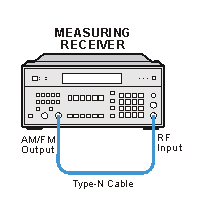
 

Measuring Receiver Calibration Setup


Residual FM Test Setup

In Case Of Difficulty

The actual Residual FM is the sum of the Residual FM in all components in the measurement system. Ensure that the Local Oscillator and Measuring receiver are not contributing excessive residual FM to the measurement. For example, make sure they are meeting their specifications.