Reference Adjustments
|

|
-
Running an adjustment will invalidate the calibration date of the module as well as the calibration information for all PXIe systems that the module belongs to.
-
In all test equipment configurations, cables
and adapters must be properly torqued. Exceeding recommended torque values
can cause damage to a cable or adapter, and can cause inaccurate test
results.
|
The Reference Adjustments runs the three adjustments available for the PXIe frequency reference.
-
OCXO Alignment
-
MUAT Tank Trim Register
-
PLL Gain Calibration
OCXO Alignment
The OCXO alignment adjusts the frequency of the PXIe frequency reference module's internal reference oscillator (OCXO) to 10 MHz. With the module at stable temperature, the frequency of the OCXO is compared against a high precision reference connected to the Flex Reference Input. the RefAdj register [1] is adjusted to minimize the difference between the internal OCXO reference and the 10 MHz output of the phase locked loop (PLL) that is locked to the Flex Reference Input.
MUAT Tank Trim Register Adjustment
This calibration adjusts the PXIe frequency reference module's TankTrim register to maximize the output voltage of the MUAT tank circuit. This calibration is performed when the MUAT is locked to the OCXO.
PLL Gain Calibration
This adjustment uses the ManualTune register to manually tune the MUAT voltage controlled oscillator (VCXO) while measuring the MUAT tuning voltage and the frequency offset of the VCXO. The calibration sweeps through ManualTune register settings and constructs a curve of frequency offset versus tuning voltage (Hz/V) at each register setting. The slope of this curve is then calculated.
Required Test Equipment
|
Test Equipment
|
Recommended Models
|
|
Precision 10 MHz Reference
|
Microsemi 5071A
|
|
Cable, BNC (m) to SMB (f)
|
8121-2063
|
Connections and Setup Procedures
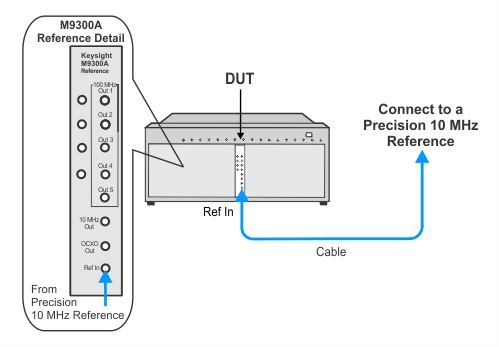
Setup for Reference Adjustments