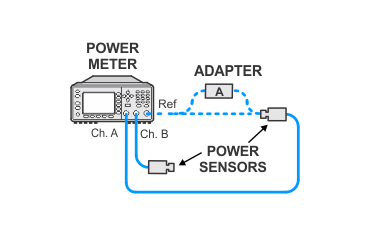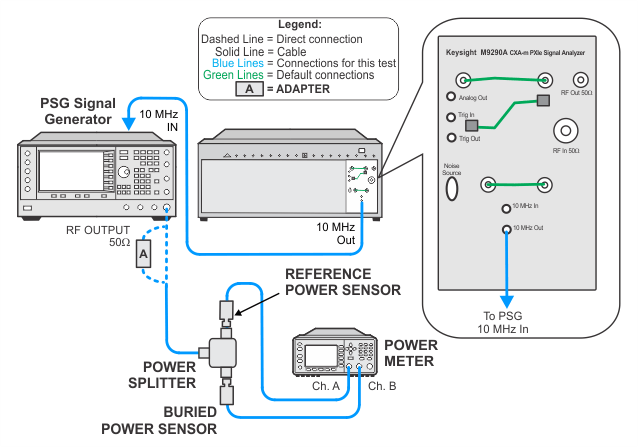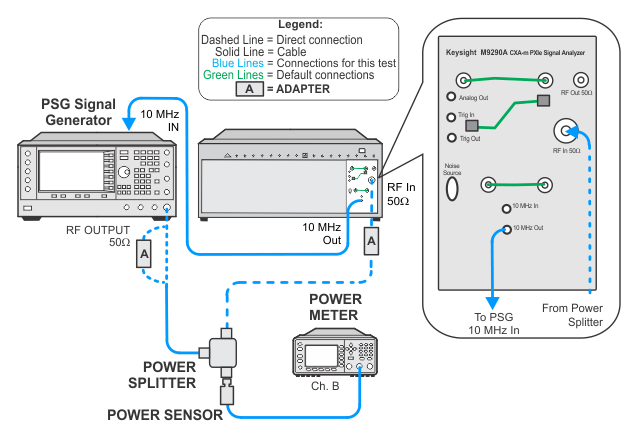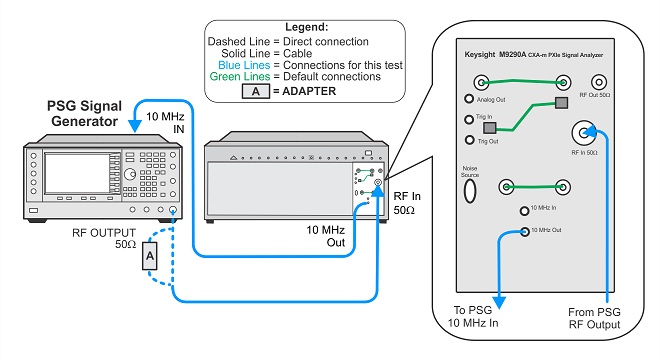
This adjustment is run on Options F13 and F26.
This adjustment is performed in two steps. The first step determines the frequencies which the frequency response will be adjusted (this step is called adaptive flatness). The second step determines the DUT frequency response correction at the frequencies determined in step 1.
The adaptive flatness routine plots out the uncorrected frequency response on the DUT trace. This is done by placing the DUT trace in max hold, then sweeping a source through the frequency band of interest. The trace can be seen as plot of conversion loss versus frequency. The trace data is then extracted from the DUT and processed.
At each correction frequency, the DUT's conversion loss is measured. The loss is normalized to the loss at 50 MHz and this number is placed in the DUT memory. Flatness corrections are generated for each attenuator step. The DUT measurement application uses these stored corrections to make accurate amplitude measurements.
The related performance test for this adjustment is Freq Resp High Freq Preamp Off.
|
Test Equipment |
Recommended Model Number1 |
|---|---|
|
Microwave signal generator #1 |
PSG models |
|
Power meter |
N1914A |
|
Microwave power sensor
|
N8485A CFT |
|
Power splitter |
11667B |
|
Cable, BNC (m) to SMB (f) |
8121-2063 |
|
Cable, Coaxial 3.5 mm (m) to 3.5 mm (m) |
11500E |
|
Adapter, 3.5 mm (m) to 3.5 mm (m)2 |
83059A |
|
Adapter, 3.5 mm (f) to 3.5 mm (f)
|
83059B |
|
Adapter, 2.4 mm (f) to 3.5 mm (f)
|
11901B |
|
Adapter, 3.5 mm (f) to Type-N (m)
|
08485-60005 |
|