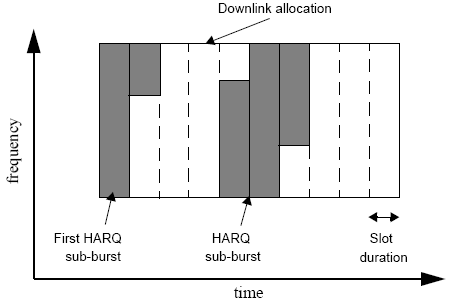
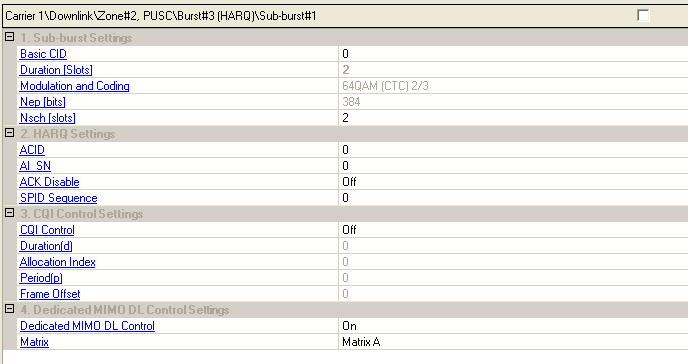
The figure above shows the definition of HARQ burst allocation. Each sub-burst size is indicated by the "Duration” property and slots are allocated in frequency-first order from the end of last sub-burst. For the last sub-burst, if assigned slots are larger than occupied slots, 0xff will be padded to make the data block fit the assigned slots size.
At least one MAC PDU is defined in the HARQ sub-burst, otherwise, an error will be displayed on status bar. You can add, delete, copy or change the order of MAC PDUs. To generate a sub-burst, ccitt-16 bit CRC is appended to the concatenated MAC PDUs after padding and then channel coding is applied to the data block.
When allocated in a non-STC zone, the parameters for IR CTC HARQ Sub-burst are:
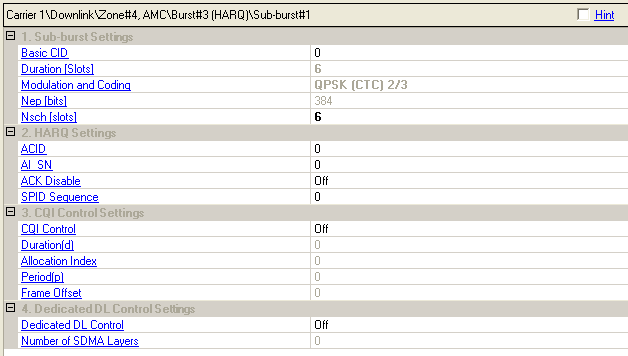
When allocated in an STC zone, the parameters for IR CTC HARQ Sub-burst are:
Range: 0 to 65535
Enter the Basic Connection ID that indicates a specific subscriber station where the HARQ DL MAP IE are described for.
Displays how many slots are needed for the HARQ sub-burst based on the total length of sub-burst after CRC calculation. The value of this parameter should be the least number of slots that can accommodate "Sub-burst length” + 16 bits "CRC” data. Padding bits is appended before CRC when the allocation is larger than needed.
Displays the modulation and FEC coding type used for the sub-burst, which is determined by the combination of Nep and Nsch. Refer to Table 534/536 in P802.16Rev2/D6 for details.
RAW – data is mapped to the OFDMA user carriers without any randomizing, encoding, or interleaving.
CC – data is randomized, encoded using convolutional coding, and interleaved according to the standard specifications.
CTC – data is randomized, encoded using convolutional turbo coding, and interleaved according to the standard specifications.
Choices: 144, 192, 288, 384, 480, 960, 1920, 2880, 3840, 4800
Displays the number of bits in the encoder packet. This value is automatically updated depending on the length of PDUs defined in the sub-burst. Refer to Table 534 in P802.16Rev2/D6 for details.
Range: 1 to 480
Enter the number of slots allocated to the encoded packet. Refer to Table 534 in P802.16Rev2/D6 for details.
For some allocations, actually assigned slots may be larger than Nsch, such as Retangular allocation or last sub-burst allocation in frequency-first manner. In these cases, the extra slots will be filled with symbols that are modulated with uncoded padding bits(all 1s).
Range: 0 to 15
Enter the ARQ Channel ID that indicates a specific HARQ transmission between a base station and subscriber station. This is used in the HARQ MAP IE.
Range: 0 to 1
Enter the AI_SN (ARQ Identifier Sequence Number) value of a specific HARQ transmission. When the AI_SN field in the HARQ channel remains the same between two HARQ burst allocations, the sub-burst is retransmitted. This is used in the HARQ MAP IE.
Choices: On, Off
Select the ACK Disable status that indicates whether the allocated sub-burst requires an ACK to be transmitted by subscriber station. This is used in the HARQ MAP IE. This parameter determines the number of ACK channels.
Range: 0 to 3
Enter the sequence string of subpacket IDs, using comma(',') as the separator. This sequence will be automatically repeated or truncated depending on the number of build frames.
For example, sequence '0,1,2,3' indicates all the four SPIDs will be used in generating multi-frame waveform.
Choices: On, Off
Select the state of CQI Control that indicates whether CQI Control information will be included in the HARQ DL MAP IE.
Only when this parameter is set to On, Duration(d) becomes configurable.
Only when CQI Control is set to On and Duration(d) is set to none zero, Allocation Index, Period(p) and Frame Offset become configurable.
Range: 0 to 15
Enter the duration value d that indicates a CQI feedback is transmitted on the CQI channels by the subscriber station for 2^(d-1) frames. This is used in the HARQ DL MAP IE.
If d is 0b0000, de-allocates all CQI feedback when the current ACID is completed successfully.
If d is 0b1111, the subscriber station should report until the base station command for the subscriber station to stop.
When Duration (d) is set to 0, Allocation Index, Period (p) and Frame Offset are disabled and grayed.
Range: 0 to 63
Enter the index of the channel in a frame the CQI report should be transmitted by the subscriber station. This is used in the HARQ DL MAP IE.
Range: 0 to 7
Enter the period value p that indicates a CQI feedback is transmitted on the CQI channels indexed by the (Allocation Index) by the subscriber station in every 2^p frames. This is used in the HARQ DL MAP IE.
Range: 0 to 7
Enter the frame offset value that indicates subscriber station starts reporting at the frame of which the number has the same 3 LSB as the specified frame offset. This is used in the HARQ DL MAP IE.
Choices: On, Off
Select the state of Dedicated DL Control that indicates whether the Dedicated DL control information will be included in HARQ DL MAP IE.
Range: 0 to 3
Enter the total number of SDMA (spatial division multiple access) layers associated with HARQ MAP IE when Dedicated DL Control is set to On.
Choices: On, Off
Select the state of Dedicated MIMO DL Control that indicates whether the Dedicated MIMO DL control information will be included in HARQ DL MAP IE.
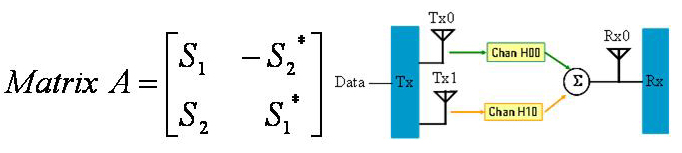
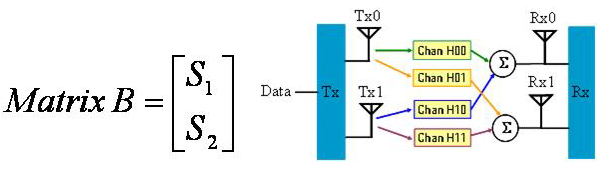
Choices: Matrix A, Matrix B
Select the transmission matrix indicator.
: Also
known as Space-Time Code (STC). Transmit diversity is supported to provide
spatial diversity and reduce fading margin. For STC, the number of transmitter
antennas is 2 and the number of receiver antennas is equal to or greater
than 1.  View illustration.
: Also
known as Spatial Multiplexing (SM) or MIMO. Multiple streams are transmitted
over multiple antennas to achieve higher throughput. For MIMO, the number
of transmitter antennas is equal to 2. The number of the receiver antennas
is equal to or larger than 2. View illustration.