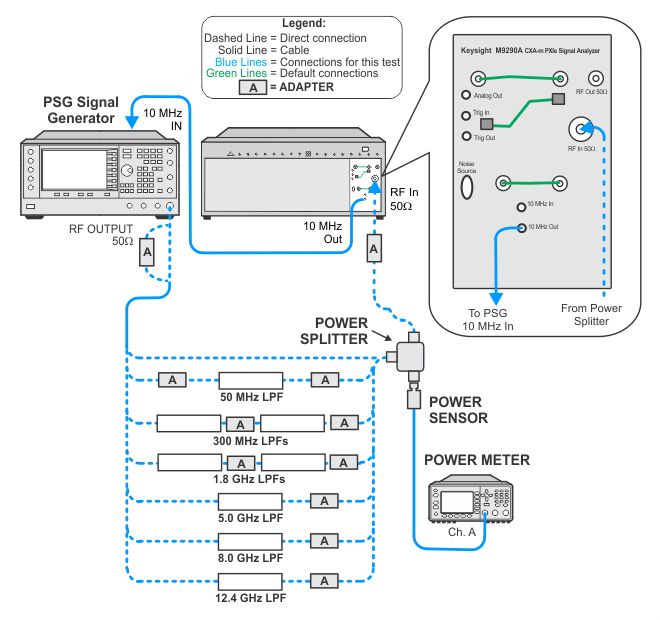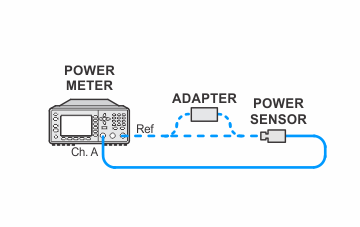
At each test frequency a –30 dBm signal is applied to the mixer. One or more low pass filters are inserted between the source and the DUT to prevent the second harmonic of the source from artificially raising the second harmonic product as it is displayed on the DUT. The Marker Delta function is used to measure the level of the distortion product relative to the carrier. The Second Harmonic Intercept point (SHI) is calculated through the equation SHI = Mixer Level - Distortion.
|
Test Equipment |
Recommended Model Number1 |
|---|---|
|
Microwave signal generator #1 |
PSG models |
|
Power meter |
N1914A |
|
Microwave power sensor |
N8485A CFT |
|
Power splitter |
11667B |
|
Low pass filter, 50 MHz |
Telonic Berkeley TLA 50-5AB2 |
|
Low pass filter, 300 MHz
|
Telonic Berkeley TLA 3000-4AB4 |
|
Low pass filter, 1.8 GHz
|
RLC L-1636 |
|
Low pass filter, 5.0 GHz
|
RLC F-30-5000-RF |
|
Low pass filter, 8.0 GHz
|
RLC F-30-8000-RF |
|
Low pass filter, 12.4 GHz
|
RLC F-30-12.4-RF |
|
Cable, BNC (m) to SMB (f) |
8121-2063 |
|
Cable, Coaxial, 3.5 mm (m) to 3.5 mm (m) |
11500E |
|
Adapter, BNC (m) to 3.5 mm (f) |
1250-1700 |
|
Adapter, BNC (f) to 3.5 mm (m) |
1250-1200 |
|
Adapter, 3.5 mm (m) to 3.5 mm (m)2
|
83059A |
|
Adapter, 3.5 mm (f) to 3.5 mm (f)
|
83059B |
|
Adapter, 2.4 mm (f) to 3.5 mm (f)
|
11901B |
|
Adapter, 3.5 mm (f) to Type-N (m)
|
08485-60005 |
|