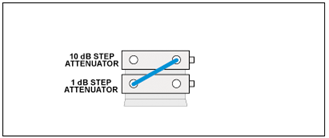
This section lists the test equipment needed to run performance tests, adjustments, and utilities. Models for each test equipment category are given in order of preference. Alternate models are also listed but should be considered a lower priority. All equipment is Keysight, Agilent, or Hewlett Packard unless otherwise specified. Refer to each individual test for specific setup configurations with required cables and adapters.
|
Test Equipment |
Recommended Model |
Alternate Model |
|
Signal Sources |
||
|
Microwave |
E8257D Options 567, 1EA/1EU, 1E1, 007
|
PSG2 |
|
Microwave
|
E8257D Options 1EA/1EU |
PSG |
|
Ultra Low Noise Reference Frequency Source |
Wenzel Associates Inc.3 |
Wenzel Associates Inc.3 |
|
Function generator |
33622A |
33611A |
|
Signal Analyzers |
||
|
Signal analyzer
|
N9030A |
E4440A |
|
Counters |
||
|
Frequency counter |
53230A |
53132A |
|
Power Meters and Sensors (See below for calibration service ordering guidelines.) |
||
|
Power meter |
N1914A4 |
N1912A E4419A |
|
RF power sensor, Type-N |
N8482A CFT |
N8482A (Non-H84 sensors will increase measurement uncertainty.) |
|
RF power sensor
|
E9304A Option H20 |
E9304A Option H18 |
|
Microwave power sensor, 3.5 mm
|
N8485A CFT |
N8485A |
|
Low power microwave power sensor, 3.5 mm
|
8485D |
|
|
Power splitter, 3.5 mm |
11667B |
11667A
|
|
Standards |
||
|
Frequency standard |
Microsemi 5071A |
5061B Option 004 |
|
Attenuators |
||
|
10 dB step7, 8
|
8496G Options 001, H50 |
8496H Options 001, H50 |
|
1 dB step7, 8
|
8494G Options 001, H50 |
8494H Options 001, H50 |
|
10 dB fixed
|
8491A Options 010, H339 |
8491B Options 010, H33 |
|
6 dB fixed
|
8491A Options 006, H339 |
8491B Options 006, H33 |
|
3 dB fixed
|
8491A Option 003 |
8491B Option 003 |
|
10 dB fixed
|
8493C Option 010 |
|
|
20 dB fixed
|
8493C Option 020 |
8491A/B Option 020 |
|
30 dB fixed
|
11708A |
|
|
Interconnect Kit
|
11716A |
|
|
Attenuator driver
|
11713B |
11713A |
|
Terminations |
||
|
50 Ω, 3.5 mm (m) |
909D |
|
|
Filters |
||
|
Low pass filter, 50 MHz, BNC (m) to BNC (f) |
Telonic Berkeley TLA 50-5AB2 |
0955-0306 |
|
Low pass filter, 300 MHz, BNC (m) to BNC (f)
|
Telonic Berkeley TLP 300-4AB4 |
0955-0455 |
|
Low pass filter, 1.8 GHz, SMA (f) to SMA (f)
|
RLC L-1636 |
0955-0491 |
|
Low pass filter, 5.0 GHz, SMA (f) to SMA (f) |
RLC F-30-5000-RF |
|
|
Low pass filter, 8.0 GHz, SMA (f) to SMA (f) |
RLC F-30-8000-RF |
|
|
Low pass filter, 12.4 GHz, SMA (f) to SMA (f) |
RLC F-30-12.4-RF |
|
|
Miscellaneous Devices |
||
|
Directional bridge, Type-N (f) |
86205A |
|
|
Directional coupler, 3.5 mm (f) |
87300C |
87300B
|
|
Cables |
||
|
Type-N (m) to Type-N (m)
|
11500C |
|
|
Viking
|
8120-2703 |
|
|
BNC (m) to SMB (f) |
8121-2063 |
|
|
Coaxial, 3.5 mm (m) to 3.5 mm (m)
|
11500E |
8120-4921 |
|
BNC (m) to BNC (m) |
8120-2582 |
10503A |
|
Power sensor cable
|
11730A |
|
|
Adapters |
||
|
3.5 mm (f) to Type-N (f)
|
1250-1745 |
|
|
3.5 mm (m) to 3.5 mm (m)
|
83059A |
1250-1748 |
|
3.5 mm (f) to 3.5 mm (f)
|
83059B |
1250-1749 |
|
2.4 mm (f) to Type-N (f)
|
11903B |
|
|
2.4 mm (f) to 3.5 mm (f)
|
11901B |
|
|
3.5 mm (m) to Type-N (f) |
1250-1750 |
|
|
Type-N (f) to Type-N (f) |
1250-1472 |
|
|
Type-N (m) to BNC (f) |
1250-1476 |
|
|
BNC (f) to 3.5 mm (m) |
1250-1200 |
|
|
BNC (m) to SMA (f) |
1250-1700 |
|
|
3.5 mm (f) to Type-N (m)
|
1250-1744 |
|
|
3.5 mm (m) to Type-N (m) |
1250-1743 |
|
|
3.5 mm (f) to Type-N (m)
|
08485-60005 |
|
|
Optional Equipment |
||
|
10 MHz distribution amplifier |
Microsemi 5087B |
Microsemi 5087A |
|
||||||||||||||||||||||||||||||||||||||||||||||||||||||||||||||||||||||||||||||||||||||||||||||||||||||||||||||||||||||||||||||||||||||||||||||
Use the following guidelines to ensure power sensors used by the N7800A application receive the correct calibration service:
Order Option 1A7 when ordering new power sensors that will be used as working standards in N7800A TME calibrations.
In the Americas region, order the Keysight Technologies Cal + Measurement Uncertainty for power sensor recalibration.
Outside the Americas region, order ISO 17025/ILAC-G8 calibration service for power sensor recalibration.
When ordering periodic calibration for instruments used as lab standards in the N7800A software, we recommend using “Keysight Technologies calibration + uncertainties” for power sensors, and “Keysight Technologies calibration + uncertainties + guardbanding” for all other items (please visit Selecting the Right Calibration Services). The N7800A software incorporates the ISO GUM Uncertainty in point-to-point uncertainty calculations. The special “H-series” calibration options in this table provide lower measurement uncertainties through use of direct comparison to devices directly characterized by NPL or NIST (or another NMI). Please order Option H99 to get data on a CD for easy import into the N7800A (avoids manual entry). The overall resulting N7800A measurement uncertainties then reflects these lower device uncertainties. The equipment requirements of each N7800A calibration application are summarized in the specials calibration matrix which can be found at the Recommended Lab Standards and Special Cal Options website.
The Keysight Technologies Option H99 is a special option for the Roseville Service Center [only] which provides a CD with calibration data included as a .csv file in TME N7800A format for all power sensors used with the N7800A TME application. N7800A TME is SSU calibration software used across Keysight Technologies SSU and by many self-maintainers. H99 must be requested from the Roseville SSU upon re-calibration only of any previously purchased power sensor and not for new purchases of BID Power Sensors. This option provides for adding the calibration data to a CD and may be ordered in addition to any other required or requested Std Lab Calibration option (must also be ordered in addition to H99).
|
|
The following models are not supported by Option H99 (calibration data on a CD in .csv format):
|
To ensure data integrity for measurements carried out with TME (Test Management Environment), the following verification checks are carried out at the beginning of each test run. The checks are only performed on devices that require calibration data which directly affect the test results.
The following table lists the standard checks performed by default:
|
|
Failure to comply with the CalFactor(%) or Atten(dB) will result in test data being labeled Invalid in both the TME interface and in any report format produced from the data. |
| Device | Parameter Name and Description | Limits | A
Failure Affects: |
|---|---|---|---|
|
Noise Source |
NoiseRatio(dB)
|
Must be > 0 and ≤ 30 at all points |
All test runs |
|
Power Sensor |
CalFactor(%)
|
Must be ≥ 10% and ≤ 150% at all points. Must not be 100% (the default) at all points. |
All test runs |
|
Uncertainty(%)
|
Must be > 0 and ≤ 10% at all points |
Test runs guard banded by measurement uncertainty only |
|
|
ReflectCoeff(Mag)
|
Must be > 0 and < 0.5 at all points |
Test runs guard banded by measurement uncertainty only |
|
|
Power Sensor |
LowBandCalFactor(%)
|
Same tests as for CalFactor(%) on a one-range power sensor |
All test runs |
|
HighBandCalFactor(%)
|
Same tests as for LowBandCalFactor(%) |
All test runs |
|
|
LowBandUncertainty(%)
|
Same tests as for Uncertainty(%) on a one-range power sensor |
Test runs guard banded by measurement uncertainty only |
|
|
HighBandUncertainty(%)
|
Same tests as for LowBandUncertainty(%) |
Test runs guard banded by measurement uncertainty only |
|
|
ReflectCoeff(Mag)
|
Same tests as for ReflectCoeff(Mag) on a one-range power sensor |
Test runs guard banded by measurement uncertainty only |
|
|
Step Attenuator |
Atten(dB)
|
Must be within 1 dB of the nominal attenuation. Must not all be exactly equal to the nominal attenuation (the default) at all points except zero. Zero step is the reference and must be zero. |
All test runs |
|
Uncert(dB)
|
Must be > 0 and ≤ 0.1 dB at all points except zero. Zero step is the reference and must be zero. |
Test runs guard banded by measurement uncertainty only |
|
|
ReflSize
|
Must be > 0 and < 0.5 at all points |
Test runs guard banded by measurement uncertainty only |