Adjusting PLL Specifications for Transition Densities Other Than 50%
When Transition Density Dependent is checked, the PLL parameters you specify assume that average transition density of the measured signal is 50% (or 0.5). However, the following equations can be used to convert your desired PLL parameters at a different transition density to the values you need to specify at a transition density of 50%.
With First Order PLL Clock Recovery
For First Order PLL clock recovery, the 3 dB frequency of the JTF and the OJTF both depend on the transition density, TD, as follows. In this equation, ω′3dB is the actual 3 dB frequency of the PLL's response when you specify ω3dB in the loop bandwidth control and then measure a signal that has a transition density of TD.

Or said differently, if you want the PLL's 3 dB frequency to be ω′3dB when measuring a signal that has a transition density of TD, you should set the loop bandwidth control to ω3dB.
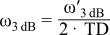
For example, if you want the PLL to have a 3 dB BW of 1 MHz at a TD of 100%, enter a Loop Bandwidth of 500 kHz.
With Second Order PLL Clock Recovery
For Second Order PLL clock recovery, the natural frequency and damping factor of both OJTF and JTF PLL responses depend on the transition density, TD, as follows. In these equations, ω′n and ζ′ are the actual natural frequency and actual damping factor of the PLL's response when you specify PLL characteristics (in the GUI controls) that have a natural frequency ωn and damping factor ζ and you then measure a signal that has a transition density of TD.


So, if you want the PLL's OJTF 3 dB frequency and damping factor to be ω′3dB and ζ′ when measuring a signal that has a transition density of TD, you can calculate the GUI control values ω3dB and ζ as follows.


If you want the PLL's JTF 3 dB frequency and peaking to be ω′3dB and H′pk when measuring a signal that has a transition density of TD, you can calculate the GUI control values ω3dB and ζ as follows. First, calculate the desired damping factor from the desired peaking.
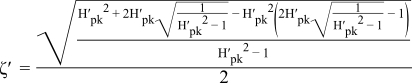
Then, calculate the peaking value to enter, Hpk, from the desired damping factor ζ′ and transition density TD values.

Finally, calculate the 3 dB BW value to enter from the desired bandwidth ω′3dB, damping factor ζ′, and transition density TD.
