Waveform Acquisition, Memory, Display, and Files
This topic explains the relationship between sampled waveforms, their display, and exported waveform files. Waveforms are stored as either single-valued (SV) or multi-valued (MV) data, depending on mode and settings. Normal sampled waveform acquisitions are SV waveforms. Real-time eye and jitter measurements work with MV waveforms.
| Single-Valued PAM4 Waveform | Multi-Valued PAM4 Waveform |
|---|---|
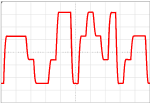
|
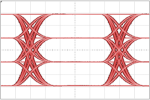
|
SV waveforms are waveforms in which each data point's time position has one and only one amplitude value. SV waveforms are stored in consecutive memory known as a waveform record. Infiniium automatically determines the waveform record's length. If needed, you can manually set the length in the Acquisition Setup dialog box.
MV waveforms are waveforms in which each data point's time position in a symbol can have multiple amplitude values. Multiple SV waveform acquisitions are combined to produce a MV waveform. This is accomplished by transferring each acquisition's waveform record immediately to a color-grade gray-scale (CGS) database. The CGS database is a 1024 rows by 1280 columns two-dimensional histogram where multiple "hits" on a single data point are counted to construct a histogram. Statistical-based measurements are performed on this histogram. Either of the two following methods is used to combine SV waveforms in the CGS database:
- Symbols regardless of boolean state or position are "wrapped" by unit interval on top of each other to produce a real-time eye diagram.
- Waveforms are displayed using color-grade or gray-scale persistence, where each acquisition's data values are superimposed on the previous acquisition's data values.