Smooth Operator
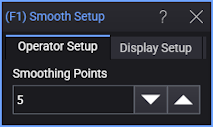
 The Smooth operator takes the number of data points as defined by the Smoothing Points control, starting from the left side of the waveform viewing, takes the average voltage value of the points, and plots it. The smoothing operator then moves to the right by one data point, takes the next set of data points, and averages them. This process continues until all of the on-screen data has been smoothed.
The smoothing operator limits the bandwidth of the waveform. You can use the following equation to calculate the bandwidth when the smoothing operator is on.

where:
- Fs = the sampling rate
- N = Smoothing Points control value
Display Setup
Each operator's setup includes a Setup section that has the selections that are shown in the following generic setup dialog box. Use these settings to control the display of the operator's output waveform, including turning the display on or off. Use the Name field to display an identifying name to the waveform which can be helpful for screen captures or when multiple waveforms are displayed. The settings also include the output waveform's color, scaling, and signal type. The scaling Automatic selection allows the output waveform to track changes to the scaling of the input waveform. This is the setting that you would normally want to use.
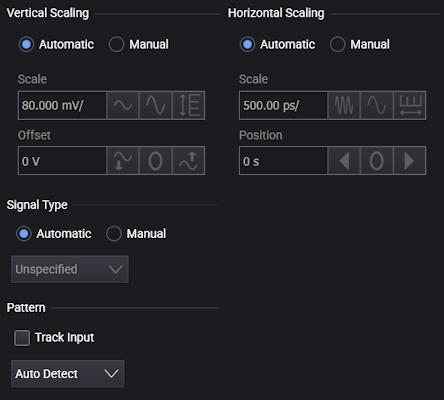
The signal Pattern can be used for BER (Bit Error Ratio), SNDR (Signal to Noise and Distortion Ratio), and other measurements. You can specify the math function has the same pattern as the input waveform (Track Input), Auto Detect the pattern, choose a Known Pattern from a list, or specify your own pattern using a Pattern File.