Preset Configurations
In the De-Embedding Network Setup dialog box, you can select from several preset configurations.
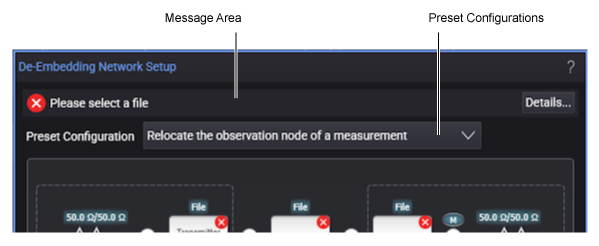
When a preset configuration is selected, its network diagram (containing the blocks, nodes, and legend) is displayed in the De-Embedding Network Setup dialog box.
2-Port De-embedding Preset Configurations
- Remove insertion loss of a fixture or cable
- Add insertion loss of a fixture or cable
- Remove all effects of a fixture or cable
- Add all effects of a fixture or cable
- Replace one channel element with another
- Relocate the observation node of a measurement
- Remove all effects of a probe
- Remove loading effects of a probe
- Remove loading effects of DDR interposer and probe
- Relocate the observation node of a probed measurement
- General purpose 3-port
- General purpose 3-port with receiver pull-up
- General purpose probe
- General purpose 6 blocks (with user defined measurement and simulation points)
- General purpose 9 blocks (with user defined measurement and simulation points)
4-Port De-embedding Preset Configurations
- Remove insertion loss of a fixture or cable
- Add insertion loss of a fixture or cable
- Remove scope input reflection
- Remove all effects of a fixture or cable
- Add all effects of a fixture or cable
- Replace one channel element with another
- Relocate the observation node of a measurement
- Remove all effects of a probe
- Remove loading effects of a probe
- Remove loading effects of DDR interposer and probe
- Relocate the observation node of a probed measurement
- General purpose 6-port
- General purpose 6-port with receiver pull-up
- General purpose probe
- General purpose 6 blocks (with user defined measurement and simulation points)
- General purpose 9 blocks (with user defined measurement and simulation points)
With the General purpose 6- and 9- block topologies, each block can be defined as having a combination of up to three elements in cascade, series, or parallel arrangements giving you 27 total possible circuit elements to define for the most sophisticated scenarios. For SMA differential probe usage, the general purpose 6- block model will find use in the majority of cases. For those very sophisticated applications (for example, using both high impedance probes and differential SMA probe heads) the general purpose model can be used to describe these complex cases.