Jitter Decomposition Model
EZJIT Plus uses the jitter decomposition model shown in the following figure to quickly estimate the TJ. In addition, this model also helps in troubleshooting the root causes of the jitter.
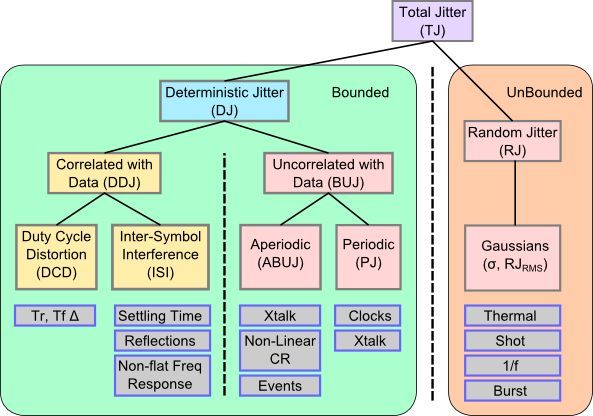
In this model, the Deterministic Jitter DJ is further broken down into:
-
Data Dependent Jitter (DDJ), which is further broken down into:
-
Duty Cycle Distortion (DCD).
-
Inter-Symbol Interference (ISI).
-
-
Bounded Uncorrelated Jitter (BUJ), which is further broken down into:
-
Aperiodic Bounded Uncorrelated Jitter (ABUJ).
-
Periodic Jitter (PJ).
BUJ and ABUJ are measured when both "spectral" and "tail fit" analysis methods are used; otherwise, when only the "spectral" analysis method is used, all the jitter that is uncorrelated with data is reported as Periodic Jitter (PJ).
-
The model also differentiates between jitter that is uncorrelated to the data pattern and jitter that is correlated to the data pattern.