Noise Decomposition Model
The Jitter/Noise analysis software uses the noise decomposition model shown in the following figure to quickly estimate the TI (Total Interference). In addition, this model also helps in troubleshooting the root causes of the noise.
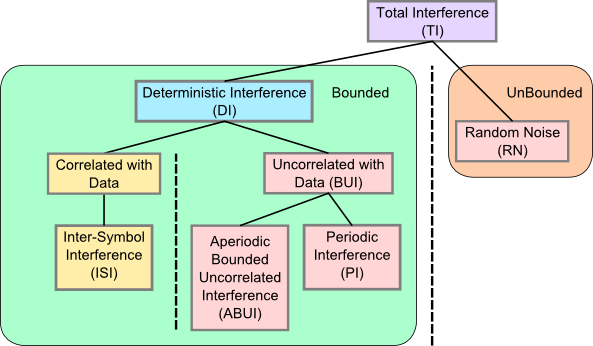
In this model, the DI (Deterministic Interference) is further broken down into:
-
Interference that is correlated with data:
-
Inter-Symbol Interference (ISI).
-
-
Interference that is uncorrelated to data:
-
Aperiodic Bounded Uncorrelated Interference (ABUI).
-
Periodic Interference (PI).
ABUI is measured when both "spectral" and "tail fit" analysis methods are used; otherwise, when only the "spectral" analysis method is used, all the interference that is uncorrelated with data is reported as Periodic Interference (PI).
-
The model also differentiates between noise that is uncorrelated to the data pattern and noise that is correlated to the data pattern.
-
Total Interference — The TI measurement is derived from the Deterministic Interference (DI) and Random Noise (RN) measurements. The DI and RN values are combined according to a dual-Dirac model. This model is converted to a BER curve which is then evaluated at the desired BER to obtain the TI measurement.
-
Random Noise — Random noise (RN) is noise that is uncorrelated to the pattern and follows Gaussian statistics.
-
Deterministic Interference — Deterministic Interference (DI) is a measure of the amount of vertical interference on a signal that is due to deterministic causes.
-
Inter-Symbol Interference (ISI) — Inter-Symbol Interference (ISI) is pattern-related interference and is a component of Deterministic Interference (DI). It is a measure of how much the amplitude of a bit depends on its location within the pattern.
-
Periodic Interference — Periodic interference (PI) is a measure of the interference that is uncorrelated to the pattern, yet is periodic. Interference caused by a switching power supply is an example of periodic interference.
-
Aperiodic Bounded Uncorrelated Interference — is a measure of the interference that is uncorrelated to the pattern and is aperiodic. Interference caused by crosstalk is an example of aperiodic bounded uncorrelated interference.
In addition to noise measurements, the Noise analysis also provides graphs of these noise sub-components.