Last Updated: August 29, 2007
This topic describes the Modulation Accuracy measurement. Modulation Accuracy is a measurement in the Power and Modulation Quality measurement suite.
The Modulation Accuracy measurement can measure both GMSK and 8PSK bursts. (8PSK measurements require an EGPRS license.)
On GMSK bursts this measurement performs a narrow-band (<200 kHz) measurement of the modulation quality and frequency accuracy of the wireless device's transmitter. The test set measures frequency error, RMS phase error and peak phase error over the useful part of the burst.
The measurement demodulates the data and compares the measured waveform with the "ideal" waveform that was expected for the data received. The frequency error is the difference in frequency, after adjustment for the effect of the modulation, between the RF transmission from the wireless device and the test set. The phase error is the difference in phase, after adjustment for the effect of the frequency error, between the wireless device and the theoretical "ideal" transmission.
On 8PSK bursts this measurement measures how much a real 8PSK modulated signal differs from an ideal 8PSK signal carrying the same information. This measurement is used to measure the modulation accuracy of an 8PSK modulated signal.
Modulation Accuracy is a measurement in the Power and Modulation Quality (PMOD) measurement suite. See Power and Modulation Quality Measurement Suite Measurement Parameters for details of the parameters that apply to all measurements in the suite.
The DSP demodulates the data and compares the measured waveform with the "ideal" waveform created by the DSP. On the front panel the measurement results are displayed both graphically and numerically.
A single burst for a GMSK measurement calculates the following:
RMS Phase Error
Peak Phase Error
Frequency Error
A multiple burst measurement is made when the multi-measurement state is on and calculates the maximum, minimum, average and standard deviation values for the above three measurements.
SCPI Commands:
A single burst for an 8PSK measurement calculates the following:
RMS EVM
95th Percentile EVM
Peak EVM
Frequency Error
Origin Offset Suppression
RMS Phase Error
Peak Phase Error
RMS Magnitude Error
Peak Magnitude Error
Amplitude Droop
IQ Imbalance
A multiple burst measurement is made when the multi-measurement state is on and calculates the maximum, minimum and average values for the above measurements except 95th Percentile EVM which is already the statistical result of all bursts combined.
SCPI Commands:
FETCh:PMODulation:MACCuracy:EVM[:BURSt([1]|2)]:EVM:RMS[:PARTial]?
FETCh:PMODulation:MACCuracy:EVM[:BURSt([1]|2)]:PEAK[:PARTial]?
FETCh:PMODulation:MACCuracy:EVM[:BURSt([1]|2)]:FERRor[:PARTial]?
FETCh:PMODulation:MACCuracy:EVM[:BURSt([1]|2)]:OOFFset[:PARTial]?
Viewing the graphical results requires an EGPRS license.
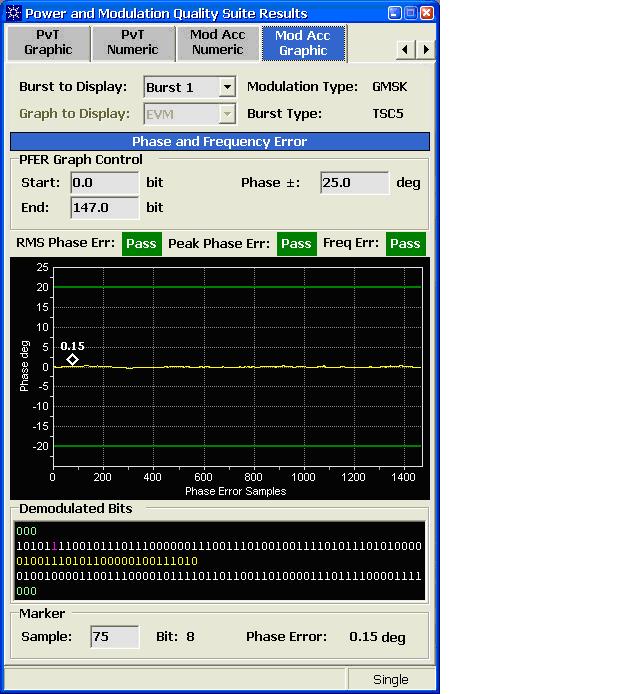
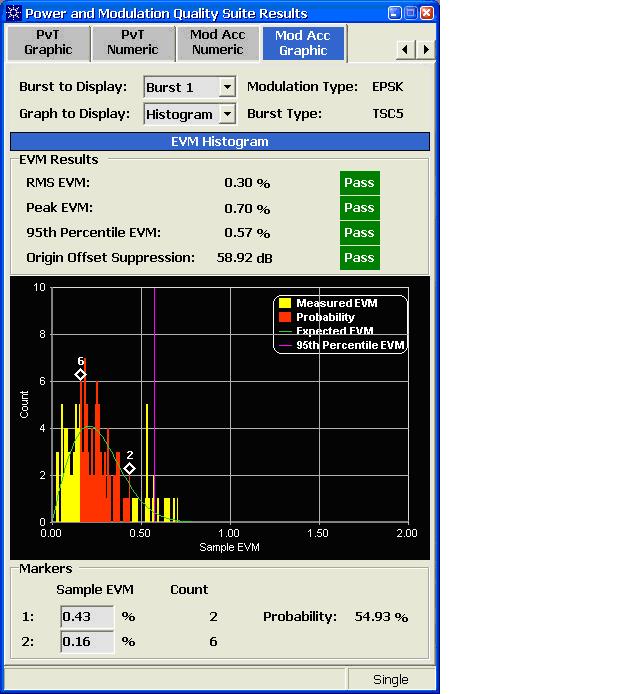
The graphical results are available on the Mod Acc Graphic tab. The screens below show some of the results available.
You can select the burst to be displayed, either Burst 1 or Burst 2. The expected Modulation Type and the Burst Type are set using the RF Analyzer.
For GMSK signals you can view a graph of the phase and frequency error, as shown below.
For 8PSK signals you can select to view either the error vector magnitude or the EVM histogram, as shown below. The error vector magnitude displays traces for EVM, magnitude error and phase error. There are softkeys available which allow you to hide or show specific traces.

Modulation Accuracy is a measurement in the Power and Modulation Quality measurement suite. See Power and Modulation Quality Input Signal Requirements for details of the input signal requirements that apply to all measurements in the suite.
