This topic contains the timing diagrams and transmitted signals for a Multiple PRACH.
The multiple PRACH feature of the instrument lets you simulate multiple UEs (user equipment/mobile) attempting to contact a base transceiver station (BTS). This feature is especially beneficial for BTS overload testing when multiple instruments are used. The following is a list of some of the characteristics you will find in the multiple PRACH feature:
80 ms transmission/time period with access slot resolution
60 access slots (80 ms / 1.33 ms = 60) numbered 0 to 59
transmission simulation of eight UEs using independent signatures that automatically assigns the channel codes in accordance with the 3GPP TS 25.213
transmission of an individual UE’s PRACH multiple times (up to 8 times) within the 80 ms time period
The number of times a UE’s PRACH can be transmitted is dependent on the number of access slots each PRACH occupies.
incorporate AWGN (additive white Gaussian noise) with the multiple PRACH transmission
transmit the preamble or the preamble plus the message part
synchronize multiple instruments to increase the number of UEs/PRACHs
The multiple PRACH feature incorporates an 80 ms time period in which to transmit the multiple PRACHs/UEs. This 80 ms period has access slot resolution, so it contains 60 selectable access slots (0 to 59). The entire 80 ms period is transmitted each time, even if only one access slot is utilized. Within this 80 ms period you have eight available UEs. All eight can be active at the same time, and each UE has the capability of transmitting its PRACH up to eight times.
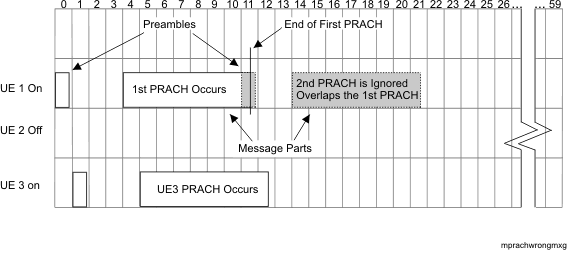
However a single UE retransmission of its PRACH cannot overlap its previous PRACH transmission within the same 80 ms period. For example, if UE1’s PRACH is 11.5 access slots long and its first PRACH transmission starts in access slot zero, then the second PRACH transmission for UE 1 must start, at a minimum, in access slot 12. If it was configured to begin in access slot 11, the second transmission would not occur because slot 11 is partially occupied by the first PRACH transmission. But different UEs can transmit in access slots occupied by other UEs. Figure 1 illustrates an example of when a PRACH retransmission for the same UE is ignored. It also demonstrates how PRACHs can occupy the same access slots when they are transmitted by different UEs.
If a third PRACH transmission was configured that overlapped the second PRACH transmission for UE1, the third transmission would occur because the second transmission is ignored/not transmitted.
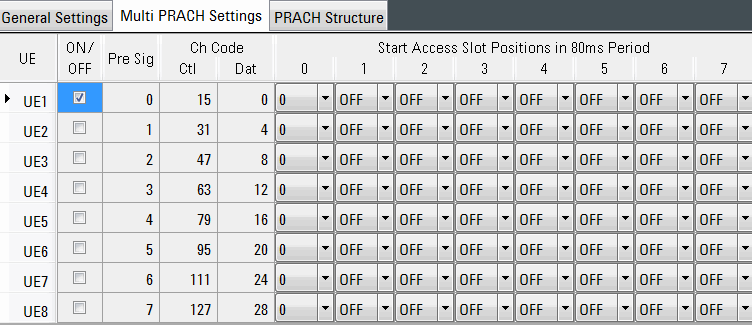
The multiple PRACH feature is configured from the factory to have UE 1 on and set to start in access slot zero. This is so you can have a PRACH signal just by turning on the PRACH Generation Mode to Multiple. See also, your instrument's documentation.
In accordance with the 3GPP standards, there are 16 different signatures to choose from for each UE, and the different signatures point to the appropriate channel codes for the control part and data part. These codes are automatically selected when a signature is chosen and are listed in the ChCode Ctl Dat columns. The control part is always spread with the channelization code of spread factor 256. The spread factor for the data part is determined by the slot format, but the node that the channelization code resides on is determined by the signature.
As seen in the  Multi PRACH Settings tab, there are eight positions per UE for assigning access slot numbers. When a position has not been assigned an access slot, the box is unchecked. If all eight positions contain unchecked boxes, this has the same affect as turning the UE off. This is because there are no PRACHs to transmit for the UE. You can transmit eight PRACHs per UE by transmitting only the preamble. Since a preamble only occupies one access slot, there would be no overlapping of the PRACH transmissions for an individual UE.
There are multiple ways the instrument can trigger external measurement equipment for measuring the multiple PRACH signal. Some examples of these are shown in the following list:
80 ms frame pulse This coincides with the frame boundaries for SFN mod 8=0.
10 ms frame pulse This denotes the SFN frame boundaries.
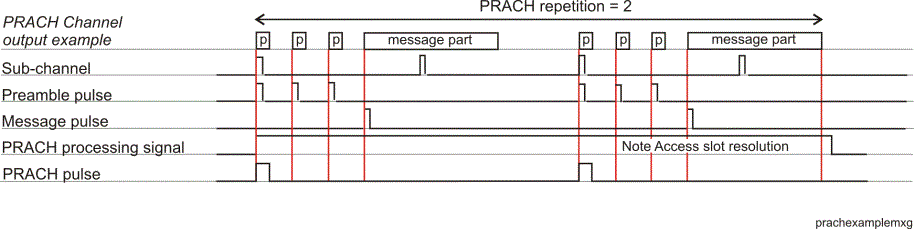
Preamble pulse This indicates the beginning of the access slot for each preamble transmission.
Message pulse This signifies the start of an access slot where the message part is being transmitted.
PRACH pulse This denotes the access slot boundaries between PRACH repetitions.
The following image, is for working with three UEs. This illustrates how different UEs can occupy the same access slots, and how to repeat/retransmit a UE’s PRACH. Figure 2 shows a graphical representation of the multiple PRACH transmission, while Figure 3 displays the same signal configuration on a signal analyzer.
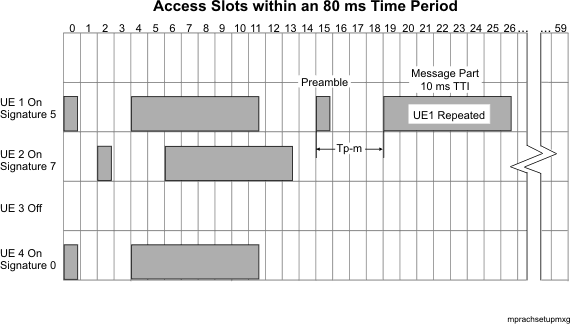
Figure 2 Multiple PRACH Timing Setup
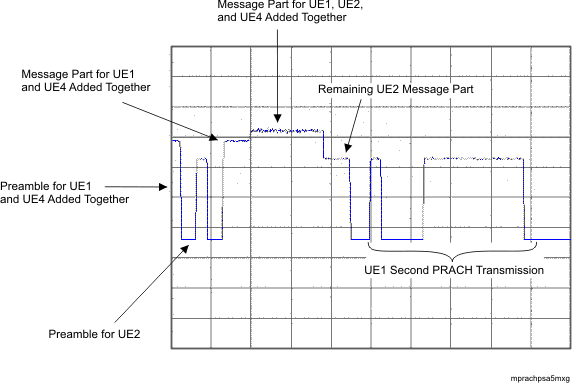
Figure 3 Transmitted Multiple PRACH Signal
Figure 4 shows an example of PRACH output timing alignment.