Waveform Files (Y Values) (.txt)
Y-value waveform files are ASCII files (.txt) comprised of a header followed by amplitude values for each data point. The ASCII amplitude values are in Volts or Watts and are separated by a carriage return and line feed. This format is convenient for transferring data to other software applications, as you can import this file into many spreadsheet or word processing programs.
Although the file does not include time values for each data point, proper X-axis scaling is achieved by XOrg (X-axis origin) and XInc (X-axis time increment) values contained in the metadata. Because individual time values are not included, this format creates smaller files than the XY-Values format.
Y-value format is designed for waveforms in which the data points are separated by equal time increments. Do not use Y-value format if any the following conditions are true. Use the XY-value format instead:
- The waveform is the output of the versus operator in a function.
Y-value format files use more disk space than HDF5 format files (.h5).
Options for saving Y-Value Waveforms (.txt format)
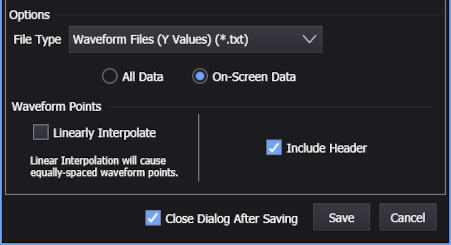
You can choose to save All Data or just the On-Screen Data.
Select Linearly Interpolate to enforce equal spacing of waveform data points. In cases where data is missing for sample locations, linear interpolation is used to fill-in the missing data values.
Clear the Include Header check box to omit header information from the saved file. Files saved without header information cannot be loaded back into waveform memories. However, you need to omit header information when using the MATLAB load() function to load waveform data.
Example Y-Value Format File
File Format, WaveformYValues
Format Version, 2
Instrument, D9300A
SwVersion, P.26.01.214
SerialNumber, MXL3441NC2
Date, 3/30/2026 13:33:17 GMT-06:00


Points, 102401
Signal Type, Unspecified
Source Name, Channel 1
Channel Noise, 0.002
Intrinsic Jitter, 1E-14
Interpolation Factor, 4
XOrg, -5.0000000000000004E-08
XInc, 9.765625E-13
Bandwidth, 128000000000
X Units, Second
Y Units, Volt
Data,
float
0.248322
0.24915977
0.25011078
.
.
.
Y-value format definition version 2 explicitly describes the precision of the Y data values (for example, 32-bit "float" in the previous example). In version 1, the Y value precision is assumed to be a 64-bit "double" (although values could have been saved with limited significant digits).