Eye Height

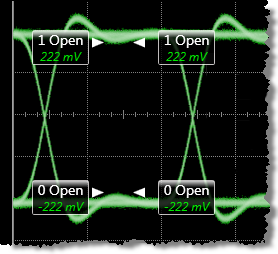 The Eye Height is a measure of the vertical opening of an eye diagram.
Four annotation labels are placed at the eye opening. Two labels are placed at the mean value of the one level and two at the mean value of the zero level. Each set of labels resides on the eye boundaries.
This measurement applies to NRZ waveforms and not to PAM waveforms.
Configurable Measurement Parameters
This measurement is affected by the following setting (choose Measure > Thresholds...):
- Eye tab
To measure
- Click Auto Scale in the menu bar.
- Click the measurement toolbar's Eye tab.
-
If necessary, click the More buttons to locate the Eye Height button, and click it to open the Eye Height dialog box.
-
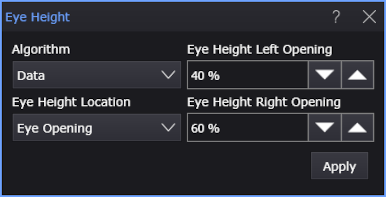
For Algorithm, select from:
-
Data — This algorithm measures the eye height within the Eye Window specified by the Eye Height Location controls described below. The smallest eye height is reported.
-
Standard Deviation — Because noise on the eye will cause the eye to close, the Standard Deviation algorithm estimates the eye height based on the mean and standard deviation of the eye top and base.
In order to make an accurate eye height measurement, histograms are constructed to characterize both the one and zero levels and their noise levels within the eye window boundaries. The one and zero level measurements are made in a section of the eye referred to as the eye window boundaries. The default value for NRZ eye window boundaries is the central 20% of the symbol period.
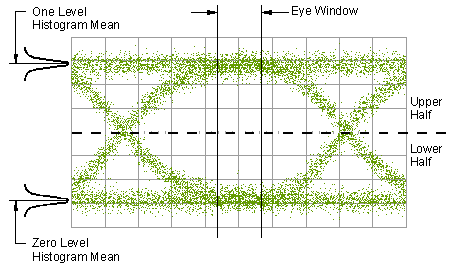
The one and zero levels are the relative means of the histograms. The noise is measured through the histograms as three standard deviations from both the one level and zero level into the eye opening.
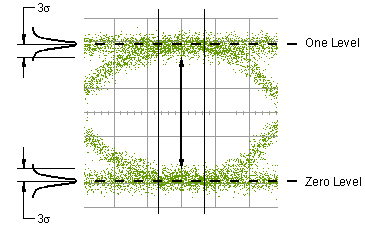

where:
- Vtop = the mean voltage of the top peak of the vertical histogram.
- σtop = the standard deviation of the top peak of the vertical histogram.
- Vbase = the mean voltage of the bottom peak of the vertical histogram.
- σbase = the standard deviation of the bottom peak of the vertical histogram.
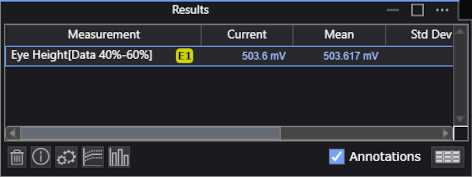
If the Data algorithm is selected, the measurement is listed in the table as Eye Height[Data]. If the Standard Deviation algorithm is selected, the measurement is listed in the table as Eye Height[SD].
-
-
For Eye Height Location, select from:
-
Eye Opening — Measures within an eye window defined by start and stop locations:
-
Eye Height Left Opening — This control sets the horizontal starting point for the eye measurement. The default Eye Height Left Opening value is 40%. Because the Eye Height Right Opening default is 60%, the middle 20% of the eye waveform data is used for the measurements.
-
Eye Height Right Opening — This control sets the horizontal stopping point for the eye measurement. The default Eye Height Right Opening value is 60%. Because the Eye Height Left Opening default is 40%, the middle 20% of the eye waveform data is used for the measurements.
-
-
Clock Time — Measures at the location of the recovered clock edge.
-
Eye Height Window Width — This control lets you specify a UI percentage width about the recovered clock location used to measure the eye height. A zero percent in this field means only the recovered clock location is used to measure the eye height.
-
-
-
Click Apply.
SCPI Command
:MEASure:EYE:EHEight