What is a real-time oscilloscope?
This topic describes traditional real-time oscilloscopes.
Real-time scope advantages:
- Able to display one-time transient events
- No explicit trigger needed
- Does not require a repetitive waveform
- Measures cycle to cycle jitter directly
- Large record lengths/deep memory
Real-Time Oscilloscopes
A real-time oscilloscope, sometimes called a “single-shot” oscilloscope, captures an entire waveform on each trigger event. Put another way, this means that a large number of data points are captured in one continuous record. To better understand this type of data acquisition, imagine it as an extremely fast analog-to-digital converter (ADC) in which the sample rate determines the sample spacing and the memory depth determines the number of points that will be displayed. In order to capture any waveform, the ADC sampling rate needs to be significantly faster than the frequency of the incoming waveform. This sample rate, which can be as fast as 80 GSa/s, determines the bandwidth which currently extends to 63 GHz.
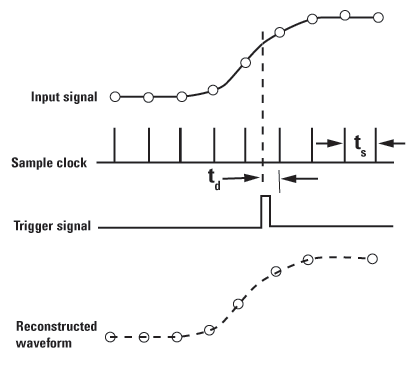
The real-time oscilloscope can be triggered on a feature of the data itself, and often a trigger will occur when the incoming waveform’s amplitude reaches a certain threshold. It is at this point that the scope starts converting the analog waveform to digital data points at a rate asynchronous and very much unrelated to the input waveform’s symbol rate. That conversion rate, known as the sampling rate, is typically derived from an internal clock signal. The oscilloscope samples the amplitude of the input waveform, stores that value in memory, and continues to the next sample as illustrated in Figure 1. The trigger’s main job is to provide a horizontal time reference point for the incoming data.
Waveform Acquisition Using a Real-Time Oscilloscope