Waveform Acquisition, Memory, Display, and Files
This topic explains the relationship between sampled waveforms, their display, and exported waveform files. Within Infiniium 2026, waveforms are stored as either single-valued (SV) or multi-valued (MV) data, depending on mode and settings.
| PAM4 Waveform | PAM4 Eye Diagram |
|---|---|
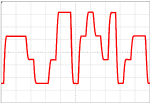
|
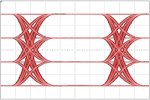
|
SV waveforms are waveforms in which each data point's time position has one and only one amplitude value. SV waveforms are stored in consecutive memory known as a waveform record. Infiniium automatically determines the waveform record's length. If needed, you can manually set the length.
MV waveforms are waveforms in which each data point's time position in a symbol can have multiple amplitude values. Multiple SV waveform acquisitions are combined to produce a MV waveform. This is accomplished by transferring each acquisition's waveform record immediately to a color-grade or gray-scale (CGS) database. The CGS database is a 1279 by 1023 two-dimensional histogram where multiple "hits" on a single data point ("pixel") are counted to construct a histogram. Statistical-based measurements are performed on this histogram. Either of the two following methods is used to combine SV waveforms in the CGS database:
- Overlaid waveforms showing gray-scale or color-grade persistence.
- Overlaid (or "wrapped") UIs (Unit Intervals) aligned by recovered clock edges to produce a real-time eye diagram.