Remove S4P Operator
 Use the Remove S4P function to remove the effects of a four-port element from your measurements. This operator is easier to set up than the Deembedding operator, however the measurement accuracy is reduced. Before you can use this operator, you must create an S-parameter file of the device to be removed.
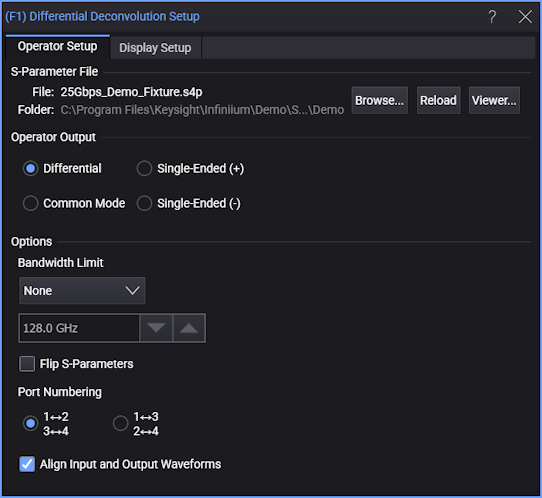
The Differential Deconvolution Setup dialog box for 4-port S-Parameter files is shown in the following figure.
Options
Use the Operator Output controls to select the transfer function output. If you want to view multiple transfer function outputs or combine them using another math function, you can set up multiple Remove s4p operators.
-
Differential — Outputs the differential side of the mixed-mode transfer function applied to the two inputs.
-
Common Mode — Outputs the common mode side of the mixed-mode transfer function applied to the two inputs.
-
Single-Ended (+) — Outputs the single-ended plus side of the transfer function applied to the two inputs.
-
Single-Ended (-) — Outputs the single-ended minus side of the transfer function applied to the two inputs.
If needed, use the Bandwidth Limit fields to minimize effects caused by noise that occurs above the frequency where the signal is mostly attenuated. Normally the Infiniium automatically sets the bandwidth limit.
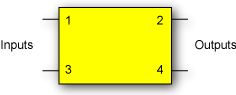
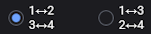
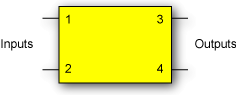
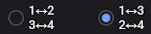
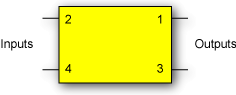
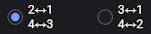
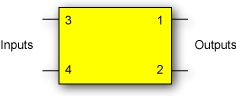
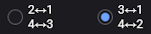
Use the Flip S-parameters and 4 Port Numbering fields to compensate for reversed port numbering in the file. If the file's S-parameter data is not defined with the ports located as shown in the following diagram, select Flip S-parameters. In addition, make the option selections as shown in the following table for the Port Numbering field. This ensures that the S-parameter order is properly interpreted.
| Port Configuration in File | Flip Model Setting | 4 Port Numbering Setting |
|---|---|---|
|
|

|
|
|
|
|
|

|
|
|
|
|
Clear the Align Input and Output Waveforms field to view the delay introduced by your device. By default, this field is normally selected and the input and output waveforms are aligned.
Click Viewer... to open the S-Parameter/Transfer Function Viewer where you can chart S-parameter and transfer function responses.
This operator requires a single-valued waveform, as opposed to an eye diagram. Be sure that your trigger setup results in a single-valued waveform at the input to this operator.
The convolution process used by this operator requires that the measurement circuit and the simulation circuit be linear and time-invariant (small-signal analysis requirements).
Jitter measurements can be made on the Remove S4P operator's output waveform.
To Configure the Operator
- Drag the operator into the construction area.
- Click on the operator to open the Deconvolution Setup dialog box. The dialog box's message prompts you to open a four-port S-parameter file for your device.
- Click Browse to locate the S-parameter file for your device.
- Select the device's Operator Output configuration.
- Use the Flip S-parameters and 4 Port Numbering fields to indicate the DUT's port orientations.
- Close the dialog box.
Display Setup
Each operator's setup includes a Setup section that has the selections that are shown in the following generic setup dialog box. Use these settings to control the display of the operator's output waveform, including turning the display on or off. Use the Name field to display an identifying name to the waveform which can be helpful for screen captures or when multiple waveforms are displayed. The settings also include the output waveform's color, scaling, and signal type. The scaling Automatic selection allows the output waveform to track changes to the scaling of the input waveform. This is the setting that you would normally want to use.
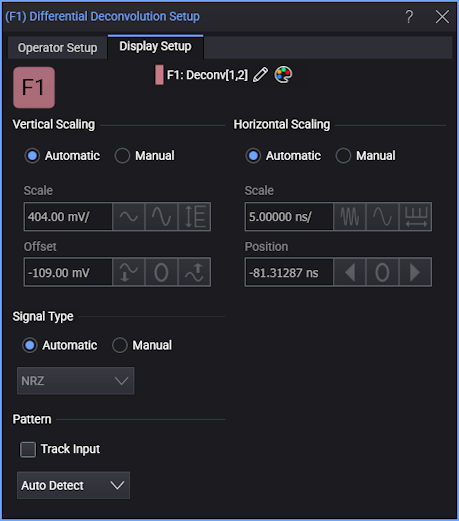
The signal Pattern can be used for BER (Bit Error Ratio), SNDR (Signal to Noise and Distortion Ratio), and other measurements. You can specify the math function has the same pattern as the input waveform (Track Input), Auto Detect the pattern, choose a Known Pattern from a list, or specify your own pattern using a Pattern File.