Eye Width

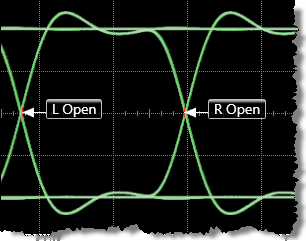 The Eye Width is a measure of the horizontal opening of an eye diagram.
Two coordinate annotation labels are placed at the eye crossings. One label is placed at the left side crossing and the other label at the right eye crossing.
This measurement applies to NRZ waveforms and not to PAM waveforms.
Configurable Measurement Parameters
This measurement is affected by the following setting (choose Measure > Thresholds...):
- Eye tab
To measure
- Click Auto Scale in the menu bar.
- Click the measurement toolbar's Eye tab.
-
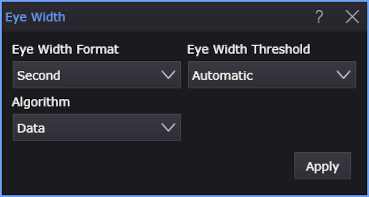
If necessary, click the More buttons to locate the Eye Width button, and click it to open the Eye Width dialog box.
-
For Eye Width Format, select from Second or Unit Interval.
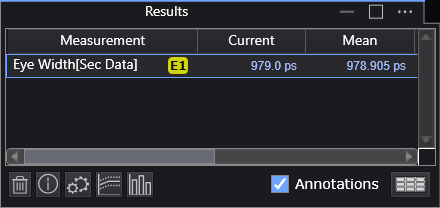
If Second format is selected, the measurement is listed in the table as Eye Width[Sec]. If Unit Interval format is selected, the measurement is listed in the table as Eye Width[UI].
-
For Eye Width Threshold, select from:
-
Automatic — Eye Widths are measured at the widest point of the eye crossings. This measurement may be inaccurate if excessive jitter causes difficulty determining the eye crossing.
-
Meas Threshold — Eye Widths are measured at the measurement threshold voltage level that you specified in the Configure Measurements dialog box. This threshold may have been automatically calculated (see General Thresholds).
-
-
For Algorithm, select from:
-
Data — This algorithm measures the eye width within the crossings. The smallest eye width is reported.
-
Standard Deviation — Because jitter may appear on the waveform and influence the eye opening, the Standard Deviation algorithm estimates the eye height based upon the mean and standard deviation of the crossings.
To compute eye width using this algorithm, the crossing points of the eye are first located. Then a vertically thin measurement window is placed horizontally through the crossing points. The data within this measurement window is analyzed. This measurement window is created to be extremely small so that the width of the crossing points is not affected by the rise time and fall time of the waveform.
The eye width is determined by measuring the noise through the histograms as 3σ (standard deviation) from both the crossing points into the eye opening.
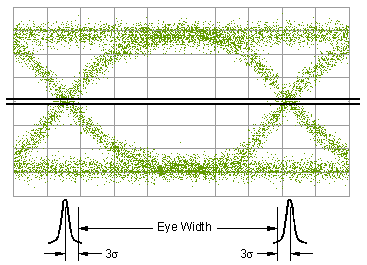

where:
- tcrossing2 = the mean time value for the second crossing point.
- σcrossing2 = the standard deviation for the second crossing point.
- tcrossing1 = the mean time value for the first crossing point.
- σcrossing1 = the standard deviation for the first crossing point.
-
-
Click Apply.
SCPI Command
:MEASure:EYE:EWIDth