Pulse Width
 Pulse Width measures the width of positive or negative pulses.
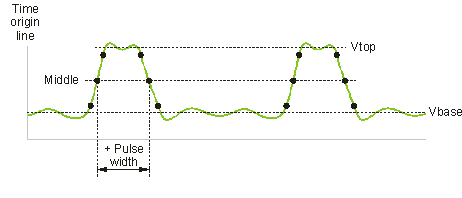
A positive pulse is defined as the time from the middle threshold of the first rising edge to the middle threshold of the next falling edge.
A negative pulse is defined as the time from the middle threshold of the first falling edge to the middle threshold of the next rising edge.
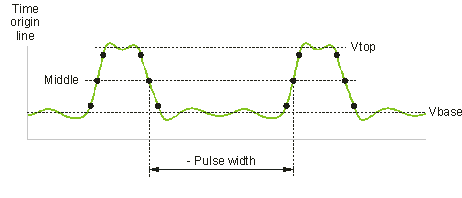
The start and stop points of the "current" pulse width measurement are marked by two waveform annotation labels.
The lower and upper threshold levels do not directly affect the pulse width measurement. However, the lower and upper threshold levels are used to determine whether or not a waveform edge is valid for the measurement.
The pulse width measurement can be restricted to a region.
This measurement is designed for single-valued waveforms only.
This measurement is not compatible with PAM signals.
Configurable Measurement Parameters
This measurement is affected by the following settings (choose Measure > Thresholds...):
- Thresholds tab
To measure
- Click the toolbar's Time tab.
- If necessary, click the toolbar's More buttons to locate the Pulse Width button, and click it.
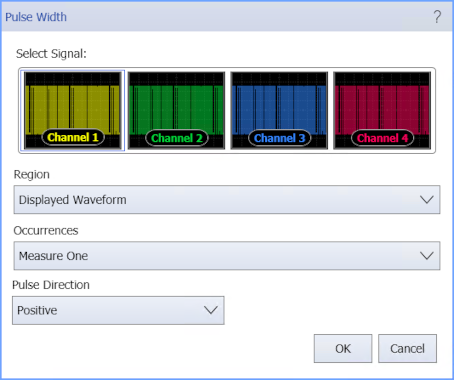
- Select the signal on which to make the measurement.
- Select the Region in which to make the measurement:
- Displayed Waveform — is what you see in the waveform window (which can be a zoomed-in view of the complete waveform).
- Entire Waveform — specifies the complete waveform.
- Region N — If regions are enabled for the selected signal, you can select one of those regions.
- Select the number of Occurrences to measure per acquisition:
- Measure One — makes one measurement per acquisition using edges closest to the timebase reference.
- Measure All — makes as many measurements per acquisition as possible using all edges in the acquisition. In this case, the measurement closest to the timebase reference is the "current" measurement (and is the one with annotations).
- Select the pulse direction to specify Positive or Negative pulse widths.
SCPI Command
:MEASure:HORizontal:PWIDth