Waveform Generation Parameters (Flex Frame - Basic and Advanced Modes)
The Waveform Generation parameter group configures the settings needed to define the generated Flex Frame signal, predistort the waveform with the measured EQ response, add AWGN Additive White Gaussian Noise - Statistically random radio noise characterized by a wide frequency range with regards to a signal in a communications channel. and recall as a recording, save to a file or download to a source.
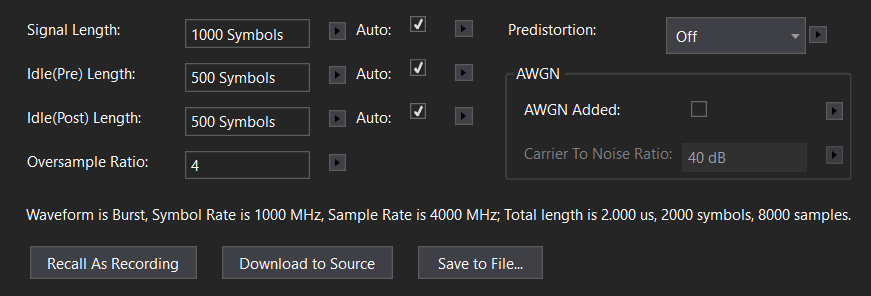
– Specifies the signal length. When Auto is enabled, if the signal is periodic, the waveform length is the frame length. If the signal is burst but length is variable length, the waveform length will be the result length. If the signal is burst with fixed length, the waveform length is the frame length.
Default: 1000 Symbols, Auto = Enabled (selected)
– Specifies the pre-idle length. Idle(Pre) Length is only applied when Frame Type is Burst (Advanced mode) or Pulse Search is checked (Basic mode). It is not applied to Periodic waveforms.
When Idle(Pre) Length Auto is enabled, if the signal is periodic, the length is 0. If the signal is burst, the length in seconds will be Search Length in seconds / 2.2 - signal length in seconds to make sure that the current search length contains at least 2 burst. If this value is negative, the current search length is too short for current burst and the Idle(Pre) Length will be set to 1000 to make sure the final signal is still burst. You may need to make the search length longer (> 2.2 * waveformLength) to ensure a good burst and the measurement is stable.
Default: 500 Symbols, Auto = Enabled (selected)
– Specifies the post-idle length. Idle(Post) Length is only applied when Frame Type is Burst (Advanced mode) or Pulse Search is checked (Basic mode). It is not applied to Periodic waveforms.
When Idle(Post) Length Auto is enabled, if the signal is periodic, the length is 0. If the signal is burst, the length in seconds will be Search Length in seconds / 2.2 - signal length in seconds to make sure that the current search length contains at least 2 burst. If this value is negative, the current search length is too short for current burst and the Idle(Post) Length will be set to 1000 to make sure the final signal is still burst. You may need to make the search length longer (> 2.2 * waveformLength) to ensure a good burst and the measurement is stable.
Default: 500 Symbols, Auto = Enabled (selected)
– Specifies the oversample ratio of the waveform.
Default: 4
– Applies linear channel unflatness pre-compensation (FIR Finite Impulse Response filter) to the waveform based on the measured EQ response calculated in the Eq Correction Spectrum trace.
-
Off – Predistortion is not applied to the generated waveform.
-
Measured Channel – Predistortion is applied to the waveform. When you choose to predistort the waveform with the measured EQ response (see Eq Correction Spectrum), the measured EQ response is only applied when the current measurement is successful. If the current measurement is not finished because of sync not found, the generated waveform will not be predistorted with the measured EQ response. In this case, the Predistortion setting will be Off and cannot be changed to Measured Channel.
If you are unable to select Measured Channel, make sure equalization is turned on (In Basic mode, set Demod > Equalization to Track or Hold. In Advanced mode, select a Measurement Control > Channel Estimation Source other than Off).
Default: Off
Choices: Off, Measured Channel
AWGN
– Enables or disables adding AWGN to the generated Flex Frame waveform.
Default: Disabled (cleared)
– For bursted signals, when AWGN is enabled for the waveform with the specified Carrier To Noise Ratio, the noise is added over the whole signal (active and inactive part), but the Carrier To Noise Ratio is the ratio of the active signal power over the noise power.
Default: 40 dB
IQ Impairments
– determines IQ impairments are applied to the waveform.
-
Off – IQ Impairments are not applied to the generated waveform.
-
User Defined – IQ impairments are defined using the I Offset(%), Q Offset(%), IQ Gain Imbalance(dB), IQ Quad Imbalance(deg) and IQ Time Skew(s) parameters.
-
Measured IQ Impairments –IQ impairments are applied based on the measured signal.
Default: Off
Choices: Off, User Defined, Measured IQ Impairments
– (IQ Impairments = User Defined) defines the I offset as a percentage relative to the magnitude of the I channel.
Default: 0
– (IQ Impairments = User Defined) defines the Q offset as a percentage relative to the magnitude of the Q channel.
Default: 0
– (IQ Impairments = User Defined) defines the gain difference (in dB) between Q and I channels. Positive values mean Q has more power than I.
Default: 0
– (IQ Impairments = User Defined) additional phase offset on the Q path. Positive values mean Q phase is advanced.
Default: 0
– (IQ Impairments = User Defined) defines the time delay (in seconds) applied to the Q path relative to I. Positive values mean Q is delayed.
Default: 0
Range: ± symbol duration
Read-only information about the waveform
| Advanced configuration mode | Basic configuration mode |
|
|
– Recalls the currently configured Flex Frame signal as a recording using the Waveform Generation settings. Recall As Recording automatically recalls the current waveform as a recording and begins to play it. For configurations with multiple component carriers (Advanced configuration mode), the waveform with the selected Component Carrier is recalled. If Component Carrier is set to All, only the first CC's waveform is recalled.
– Downloads a waveform created based on the current Flex Frame configuration to a properly configured, connected source. For configurations with multiple component carriers (Advanced configuration mode), the waveform with the selected Component Carrier is downloaded. If Component Carrier is set to All, only the first CC's waveform is downloaded.
– Saves the currently configured Flex Frame signal as one or more VSA MATLAB (.mat) waveform files, depending on the number of component carriers and the Component Carrier selection. For configurations with multiple component carriers (Advanced configuration mode), if Component Carrier is set to All, when you click Save to File, a file is generated for each CC.
•
See Also
