Region Table
Menu Path:
The FMCW Region Table is a type of Matrix Table that includes all region-specific result metrics, measured over all valid synchronized FM Frequency Modulation region time samples detected within the user-defined Acquisition Length (sec) up to the user specified Maximum Region Count value.
All displayed metrics in the table (except for Region Index and Reference Region ID) are measured over the region-specific FM synchronized time samples, excluding the time samples identified by the Exclude During Analysis parameter. Each row in the table has a region number (sequential numbering in the order that they are found in the acquisition) and a reference region number (each Ref Region has an FM slope and a duration) which indicates where the region is in the repeating pattern.
Region Table metrics are listed under the following groupings:
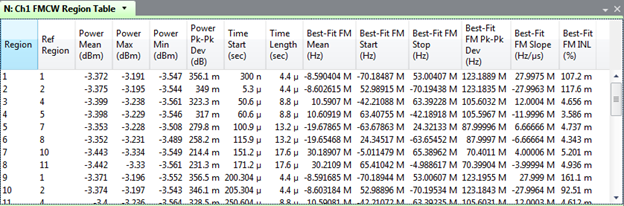
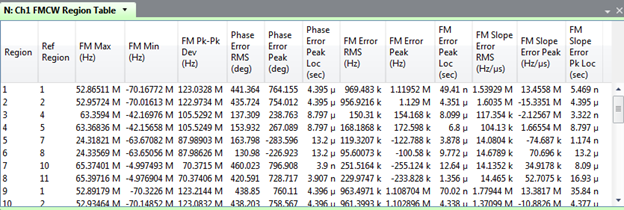
The following illustrations show an example of the Region Table configured to display Power, Time, and Best-Fit FM metrics, and another configured to display FM, Phase Error, FM Error and FM Slope Error metrics.
Region Metrics
- Region
- Region indicates the sequentially assigned region index within current measurement acquisition and corresponds with Selected Regions parameter selection values, plus region index annotation values reported within time traces when Highlight Selected Regions on Traces feature is enabled.
- Region index value 1 represents the first valid detected Analysis region within the Acquisition Length (s).
- Default visibility: ON (always visible)
- Region indicates the sequentially assigned region index within current measurement acquisition and corresponds with Selected Regions parameter selection values, plus region index annotation values reported within time traces when Highlight Selected Regions on Traces feature is enabled.
- Ref Region
- Reference Region value, indicates the assigned Ref Region identifier as defined within Manual Reference Description when Region Synchronization = Sync to Manual Reference or Triggered modes. When Region Synchronization = Automatic, the Ref Region identifier is automatically assigned based on the Reference Region Count value (which can either be an Automatic detected value or Manual specified value by user).
- Ref Region identifier range starts from value 1.
- Default visibility: ON (always visible)
- Reference Region value, indicates the assigned Ref Region identifier as defined within Manual Reference Description when Region Synchronization = Sync to Manual Reference or Triggered modes. When Region Synchronization = Automatic, the Ref Region identifier is automatically assigned based on the Reference Region Count value (which can either be an Automatic detected value or Manual specified value by user).
Selecting Regions to Analyze from the Table
You can highlight one row, then right-click and select Set Start Region to conveniently set the Starting Region.
You can also set which regions the measurement analyzes directly from the Region Table, rather than entering values in the Selected Regions parameters on the Time tab. Select one row, or a range of rows, then right-click the selection and choose one of the following commands.
- Analyze Selected Region (n) or Analyze Selected Regions (n-m)
- Sets both the Starting Region and the Number of Regions to cover the selected rows in a single step, which switches Selected Regions to Select Subset. The command name shows the region numbers that will be analyzed: it reads Analyze Selected Region (n) when one row is selected (a Number of Regions of 1), and Analyze Selected Regions (n-m) when two or more rows are selected.
- Because the measurement analyzes a contiguous range of regions, a selection that skips regions is extended to the range that spans it. Selecting only regions 3 and 9, for example, produces Analyze Selected Regions (3-9) and analyzes regions 3 through 9.
- Row selection is by region number, not by screen position, so the applied range is the same whether or not the table is sorted by another metric.
- Analyze All Regions
- Returns the measurement to analyzing every detected region, which is equivalent to choosing Select All Regions for Selected Regions. Later acquisitions that contain more regions remain fully analyzed.
- No row selection is required. This command is grayed out when the measurement is already analyzing all regions, so it also indicates the current state.
Rows whose regions fall within the currently analyzed range are shown in bold, so you can see the range at a glance. No rows are shown in bold when the measurement is analyzing all regions, because every row is included in that case. Rows outside the analyzed range continue to report their measured results.
These commands and the bold row emphasis apply to the Region Table, whose rows are the individual detected regions. They are not available on the Cumulative Stats Table, the Current Stats Table, or other statistics tables.
Sorting by metric
You can sort the table by any metric by left-clicking the metric name. Click again to toggle between ascending or descending order. Cancel sorting by right-clicking and selecting "Clear Sort".
See Also
