:DIFF:SNDRatio:RLMStandard
Command Syntax
:DIFFN:SNDRatio:RLMStandard {RLMA120 | RLMC94 | EYE}
Where N identifies a specific differential waveform in the form "<connection1-8>_<ch1|ch3|ch5|ch7>". With connection 1, the connection number part (that is, "1_") is optional, and you can simply use the channel number "<ch1|ch3|ch5|ch7>". When two channels are paired to create a differential waveform and a common-mode waveform, the odd-numbered channel is used when specifying the waveform. For example, connection 5 differential waveform 3 (from the pairing of channels 3 and 4) is DIFF5_3.
Query Syntax
:DIFFN:SNDRatio:RLMStandard?
Description
For PAM3 and PAM4 signal types (see :DIFF:SIGNal:TYPE) SNDR measurements, this command selects the RLM measurement calculation algorithm to use.
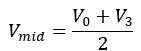
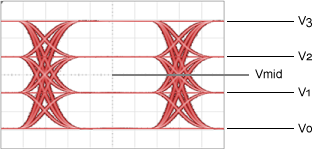
This PAM4 symbol levels picture identifies the voltage levels used in the following equations.
| Parameter | Available with signal types | Description |
|---|---|---|
| RLMA120 | PAM4 |
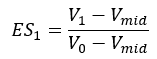
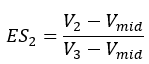
RLM (IEEE 802.3 Annex 120D) — The linearity is defined as a function of the mean signal level transmitted for each PAM4 symbol level. In the following equations, the term ES stands for the Effective Symbol Level.
|
| RLMC94 | PAM4, PAM3 |
RLM (IEEE 802.3 Clause 94). For PAM4:
For PAM3, the equation is the same except the V3 is changed to V2 and the division is by 2 instead of 3. |
| EYE | PAM4, PAM3 |
Eye Linearity (CEI 4.0) — Eye linearity is the ratio of minimum eye amplitudes (in Volts) to maximum eye amplitudes (in Volts). For PAM4:
For PAM3, the equation is the same except the Eye 2 terms are omitted. |