Optical Calibration
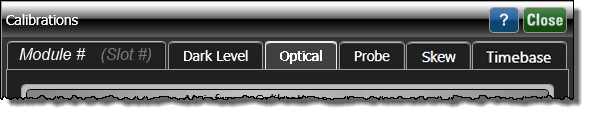
Use the Optical tab of the Calibrations dialog to calibrate an optical input channel on modules installed in a N1000A's module bay as well as DCA-M modules. Click Tools > Calibrations to open this dialog.
The Optical calibration tab is shown whenever an optical module is installed.
| Icon | Description |
|---|---|

|
Calibration is selected |

|
Calibration is unselected |

|
Calibrations are partially selected |

|
Calibration is current |

|
Calibration is recommended |

|
Calibration has never been performed |
For a N109X-series DCA-M modules and N1000A plug-in modules, you can use this dialog tab to perform optical calibrations at both factory and user wavelengths. Factory and user optical channel calibrations (also known as O/E calibration) compensate for the photo detector's responsivity. This provides both an accurate display of the received optical waveform in optical power units and an accurate measurement of the signal's average power. If you will be operating at wavelengths different from the factory-calibrated wavelengths, perform a user optical channel calibration at the desired wavelength.
If you perform an optical channel calibration at a factory-calibrated wavelength, the factory calibration will not be overwritten. The calibrations for two-slot modules are stored on the N1000A's hard drive and not on the module. The picture above shows the dialog's optical tab with the state of the calibrations.
You can create up to three user calibrations: User Cal 2, User Cal 3, and User Cal 4. To delete a user calibrations from memory click the Clear button.
To perform an optical channel calibration, an optical source with a known optical output power level is required.
Required External CW Optical Source
An external CW optical source must be used, and the wavelength and power of the optical source must be entered for the calibration. The user-defined wavelength must be within the wavelength ranges specific to each module as shown in the table below. For example, if you are operating the N1090A DCA-M module, you can select a user-defined wavelength between 750 nm and 1650 nm. The power output from the optical source must also be within the ranges specific to each module.
Do not remove a module from the N1000A during a calibration.
Minimum Power is Recommended
The minimum power level is recommended to assure specified performance over the instrument's full dynamic range. The calibration accuracy is heavily dependent on the accuracy to which you know the optical source power. For best results measure the optical source power with a high precision optical power meter.
If the result for an average power measurement (either eye/mask mode or oscilloscope mode) is an extremely large value, the instrument may have lost the factory optical channel calibration. For example, a value of 260W displayed for a 100 μW signal. You can also perform an optical responsivity calibration for a user-defined wavelength.