TDECQ Secondary Operator (Advanced)

 This topic covers configuring the TDECQ operator when it is a secondary to a Reference Receiver operator.
Low-SNR Measurement Mode
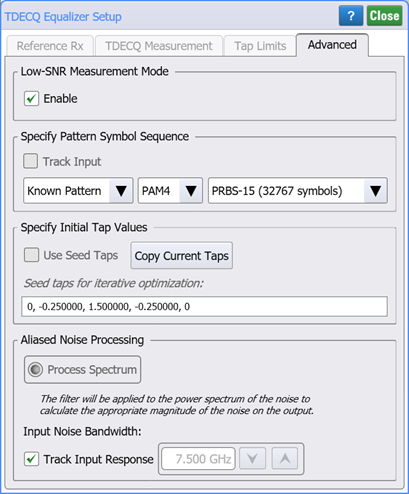
The Low-SNR Measurement Mode setting allows the TDECQ operator to operate when large amounts of noise is present on the signal. However, it is recommended that you instead use System Impulse Response Correction configured with the Intrinsic Noise/Jitter Reduction setting turned on (default setting). To locate this setting, in the Channel dialog click Configure to open the System Impulse Response Correction Setup dialog.
Starting with FlexDCA revision A.08.30, the TDECQ operator's Low-SNR Measurement Mode setting is turned off. Low-SNR Measurement Mode requires the L-RND or L-MFG package licenses.
.
If the Precision Timebase (PTB) is on, a questionable status mark (?) is placed on the measurement results. It is recommended that the Precision Timebase (PTB) be turned off when Low-SNR is enabled. This is not an issue when using the Intrinsic Noise/Jitter Reduction setting.
Specify Pattern Symbol Sequence
Use these settings to specify input waveform's pattern symbol sequence (NRZ or PAM4). You can select to have the pattern automatically detected (default), select from a know standard Known Pattern, or a BERT Pattern File (*.ptrn). Available known patterns are listed here. If you select to import a Pattern File, you can specify if the pattern uses Gray Coding. Gray coding, or reflected binary code, is a coding pattern where successive symbols differ by one binary bit. For example in the case of PAM4, binary bit sequences 00, 01,10, and 11 represent levels 0, 1, 2, and 3.
Pattern Length Selections
Availability of individual patterns depends on installed modules and other conditions.
- 20 - 2˄7-1 PRBS
- 40 - PCIe Compliance
- 62 - PAM4 Clock
- 120 - FC RPAT
- 160 - PAM4 Linearity
- 384 - 802.3ae TWDP segment
- 640 - PCIe Idle
- 1280 - FDDI Jitter
- 2280 - CRPAT
- 2640 - CJPAT
- 3360 - CRPAT (2)
- 3760 - CJPAT (2)
- 3780 - XAUI CRPAT
- 3820 - XAUE CJPAT
- 5280 - GbE Test Frame
- 7641 - XAUI CJPAT
- 9000 - JTPAT
- 18944 - CEI Stress
- 20480 - SPAT
- 20840 - CSPAT
- 21760 - CJTPAT
- 30240 - XAUI CRPAT
- 32762 - CEI SSPR
- 33792 - 10GbE
- 65535 - SSPRQ
- 90000 - FDDI Wander
- 92160 - SATA
- 311040 - SONET CID
- 127 - 2˄7-1 PRBS
- 128 - 2˄7 PRBS
- 511 - 2˄9-1 PRBS
- 512 - 2˄9 PRBS
- 1023 - 2˄10-1 PRBS
- 1024 - 2˄10 PRBS
- 2047 - 2˄11-1 PRBS
- 2048 - 2˄11 PRBS
- 8191 - 2˄13-1 PRBS
- 8192 - 2˄13 PRBS
- 32767 - 2˄15-1 PRBS
- 32768 - 2˄15 PRBS
- 65535 - 2˄16-1 PRBS
- 65536 - 2˄16 PRBS
- 1048575 - 2˄20-1 PRBS
- 1048576 - 2˄20 PRBS
- 8388607 - 2˄23-1 PRBS
- 8388608 - 2˄23 PRBS
Aliased Noise Processing
The TDECQ equalizer's Aliased Noise Processing compensates for the filter function's side effect of reducing a signals noise for adjacent measurement points. Processing noise causes the operator to quantify the noise on each point on the operator's input waveform and restore this noise on the corresponding data point on the output waveform. The processing noise setting (Process Spectrum) setting is permanently turned on and you cannot turn it off.
With the TDECQ operator, the Process Spectrum selection is the only option and is always selected. Although the other Noise Processing setting are unavailable, the following paragraphs describe the way FlexDCA generally handles noise processing with other operators.
None Selection
The option
Process Spectrum Selection
The option
The default behavior of the Process Spectrum noise processing option is to use the noise power spectrum of the input signal. If the input signal is a sampling scope channel with SIRC active, this spectrum will be established by the measured hardware response of the channel. For other channels, the response will be assumed Gaussian with a 3 dB frequency corresponding to the nominal channel bandwidth. This behavior can be overridden by clearing the Track Input Response checkbox and manually entering a bandwidth. If this option is utilized the response will be presumed Gaussian with the selected 3 dB bandwidth.
Preserve RMS Selection
The option
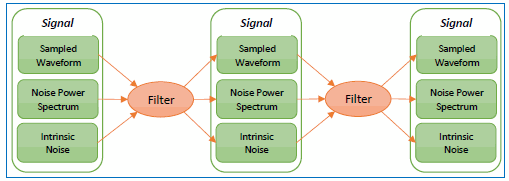
By tracking the accumulated effects of the filtering operations, accurate noise processing can be done even when chaining operations as illustrated in the following figure. In addition to the sampled waveform, information about the acquisition channel and noise power spectrum are maintained in each signal and appropriately processed by each filter. The complete set of auxiliary information is also included when storing FlexDCA waveforms in the *.wfmx file format.